
Q:
A:
UNHCR fully supports Serbia in resolving refugee problem
Belgrade,
7 September 2009
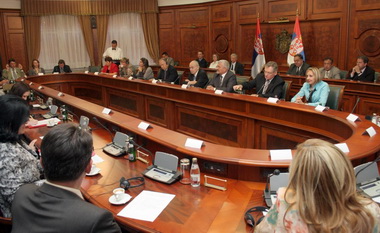
Serbian Deputy Prime Minister for social policy Jovan Krkobabic said today at a ceremony held for the signing and handing out of project contracts to selected municipalities that Serbia has the full support of the UNHCR for resolving the refugee problem.
Author:
Fonet
Krkobabic said that by the end of this year the number of refugee centres in Serbia will be reduced from 73 to 14, stressing that the problems of refugees and Internally Displaced Persons in Serbia can be resolved only through a partnership between central and local authorities.
UNHCR representative Eduardo Arboleda said that Serbia has the largest number of refugees in the region, stressing that the UNHCR recognises the immensity of the problem and is making every effort to help Serbia find a lasting solution.
He said that the UNHCR will continue helping Serbia, primarily financially but also politically, adding that the Serbian government’s most important priority should be resolving the refugee problem.
The project, Support for Local Action Plans in Serbia, which is being financed by the UNHCR with a $700,000 donation, will provide accommodation and economic help to nearly 150 refugee families.
A total of 29 municipalities competed for the funds and a committee consisting of UNHCR representatives and the Serbian Refugee Commissioner selected 12 municipalities and cities which will receive support for their refugee projects. These are Alibunar, Zajecar, Kragujevac, Krusevac, Kula, Medvedja, Nova Crnja, Novi Beograd, Pancevo, Pecinci, Ruma and Smederevo.
Serbian Commissioner for Refugees Vladimir Cucic said that the funds will be used to secure accommodation and building materials, etc. He recalled that up until now 30 municipalities and cities have adopted strategies for refugees, formed councils for migration and that in 75 municipalities training courses for designing local action plans have been held.
He said that owing to financial help from the OSCE, similar training courses will be held at 40 more municipalities by the end of 2009.
The project Support for Local Action Plans in Serbia is being financed by the UNHCR and it is being implemented by the Office of the Serbian Commissioner for Refugees.
UNHCR representative Eduardo Arboleda said that Serbia has the largest number of refugees in the region, stressing that the UNHCR recognises the immensity of the problem and is making every effort to help Serbia find a lasting solution.
He said that the UNHCR will continue helping Serbia, primarily financially but also politically, adding that the Serbian government’s most important priority should be resolving the refugee problem.
The project, Support for Local Action Plans in Serbia, which is being financed by the UNHCR with a $700,000 donation, will provide accommodation and economic help to nearly 150 refugee families.
A total of 29 municipalities competed for the funds and a committee consisting of UNHCR representatives and the Serbian Refugee Commissioner selected 12 municipalities and cities which will receive support for their refugee projects. These are Alibunar, Zajecar, Kragujevac, Krusevac, Kula, Medvedja, Nova Crnja, Novi Beograd, Pancevo, Pecinci, Ruma and Smederevo.
Serbian Commissioner for Refugees Vladimir Cucic said that the funds will be used to secure accommodation and building materials, etc. He recalled that up until now 30 municipalities and cities have adopted strategies for refugees, formed councils for migration and that in 75 municipalities training courses for designing local action plans have been held.
He said that owing to financial help from the OSCE, similar training courses will be held at 40 more municipalities by the end of 2009.
The project Support for Local Action Plans in Serbia is being financed by the UNHCR and it is being implemented by the Office of the Serbian Commissioner for Refugees.
-
 Belgrade, 24 July 2026
Serbia, Hungary partners in addressing regional security challenges
-
 Belgrade, 24 July 2026
Dačić congratulates UK Home Secretary on reappointment
-
 Belgrade, 22 July 2026
Serbia follows modern technological achievements, attracts investments
-
 Belgrade, 22 July 2026
Continued cooperation with Russia in field of security, emergency situations
-
 Belgrade, 22 July 2026
New opportunities for expanding economic cooperation between Serbia, China
-
 Belgrade, 20 July 2026
Cooperation in field of interior affairs important segment of relations with Germany
-
 Belgrade, 16 July 2026
Expo 2027 opportunity to further strengthen international partnerships
-
 Belgrade/Bratislava, 16 July 2026
Serbia, Slovakia continue to strengthen political, economic cooperation
-
 Belgrade, 14 July 2026
Serbia bilaterally resolves problems arising from EES implementation
-
 Gradina/Kalotina, 9 July 2026
Improving border cooperation between Serbia, Bulgaria