
Q:
A:
Serbia close to finalising deal with IMF
Belgrade,
28 August 2009
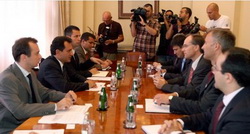
Deputy Prime Minister for EU integration Bozidar Djelic today stated that Serbia is close to signing a deal with the IMF, envisaging a budgetary deficit of 4.5% of GDP and a 9% balance of payments deficit for 2009.
Author:
Tanjug
Djelic told the press following the meeting with the IMF delegation that the deal is being made for both 2009 and 2010, adding that serious talks await Serbia in the upcoming weeks.
The arrangement we expect to reach does not imply higher VAT or other taxes because funds for covering the 4.5% deficit have been secured.
Although there have been some positive signs, Djelic said, noting the example of the growth recorded in France and Germany, the number of the unemployed is still rising and the crisis is not yet over.
We must implement savings measures at all levels in order to prevent the 2010 budget deficit from reaching 5.5% or 6% of GDP, he said.
The Minister stressed that although 3% of GDP is needed for pensions, the government has decided not to reduce them. However, the pension system must be reformed as soon as possible.
Djelic said he informed the IMF delegation of an agreement with the European Commission, according to which Serbia will receive €100 million as budget assistance in 2009.
The European Commission, however, demanded that Serbia reach an agreement with the IMF, he explained, adding that the government must continue implementing the IMF programme, as well as reforms necessary for Serbia's EU integration.
It is very important to reach agreements with the IMF for both 2009 and 2010, as the Serbian economy and citizens need long-term stability, he said, recalling that the IMF programme will be carried out by May 2011.
The two sides also discussed Serbia's EU integration from a medium-term perspective.
Serbia's main aim is to reach an agreement with the IMF concerning public sector reforms, as well as other reforms necessary for keeping its budget deficit at an acceptable level, said the Minister.
Djelic also said that Serbia will not face any difficulties regarding foreign debt servicing, recalling that since 2001 Serbia has been successfully meeting all its debt obligations.
Government measures for alleviating the consequences of the crisis have already yielded good results, said the Minister, pointing to the macroeconomic stability, the stability and solvency of the banking sector, the dinar exchange rate and a lower inflation rate.
The arrangement we expect to reach does not imply higher VAT or other taxes because funds for covering the 4.5% deficit have been secured.
Although there have been some positive signs, Djelic said, noting the example of the growth recorded in France and Germany, the number of the unemployed is still rising and the crisis is not yet over.
We must implement savings measures at all levels in order to prevent the 2010 budget deficit from reaching 5.5% or 6% of GDP, he said.
The Minister stressed that although 3% of GDP is needed for pensions, the government has decided not to reduce them. However, the pension system must be reformed as soon as possible.
Djelic said he informed the IMF delegation of an agreement with the European Commission, according to which Serbia will receive €100 million as budget assistance in 2009.
The European Commission, however, demanded that Serbia reach an agreement with the IMF, he explained, adding that the government must continue implementing the IMF programme, as well as reforms necessary for Serbia's EU integration.
It is very important to reach agreements with the IMF for both 2009 and 2010, as the Serbian economy and citizens need long-term stability, he said, recalling that the IMF programme will be carried out by May 2011.
The two sides also discussed Serbia's EU integration from a medium-term perspective.
Serbia's main aim is to reach an agreement with the IMF concerning public sector reforms, as well as other reforms necessary for keeping its budget deficit at an acceptable level, said the Minister.
Djelic also said that Serbia will not face any difficulties regarding foreign debt servicing, recalling that since 2001 Serbia has been successfully meeting all its debt obligations.
Government measures for alleviating the consequences of the crisis have already yielded good results, said the Minister, pointing to the macroeconomic stability, the stability and solvency of the banking sector, the dinar exchange rate and a lower inflation rate.
-
 Belgrade, 24 July 2026
Serbia, Hungary partners in addressing regional security challenges
-
 Belgrade, 24 July 2026
Dačić congratulates UK Home Secretary on reappointment
-
 Belgrade, 22 July 2026
Serbia follows modern technological achievements, attracts investments
-
 Belgrade, 22 July 2026
Continued cooperation with Russia in field of security, emergency situations
-
 Belgrade, 22 July 2026
New opportunities for expanding economic cooperation between Serbia, China
-
 Belgrade, 20 July 2026
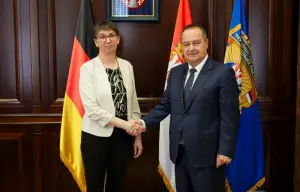
Cooperation in field of interior affairs important segment of relations with Germany
-
 Belgrade, 16 July 2026
Expo 2027 opportunity to further strengthen international partnerships
-
 Belgrade/Bratislava, 16 July 2026
Serbia, Slovakia continue to strengthen political, economic cooperation
-
 Belgrade, 14 July 2026
Serbia bilaterally resolves problems arising from EES implementation
-
 Gradina/Kalotina, 9 July 2026
Improving border cooperation between Serbia, Bulgaria