
Q:
A:
Serbia to prevent discrimination against its citizens regarding biometric passport issuance
Belgrade,
3 August 2009
Deputy Prime Minister for EU Integration Bozidar Djelic today stated that Serbia will not discriminate against its citizens when it comes to issuing new biometric passports.
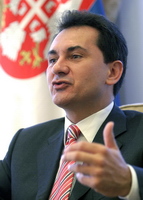
File photo of Bozidar Djelic
Author:
Fonet
In an interview with the Tanjug news agency Djelic explained that the government will make maximum efforts not only to provide biometric passports to Kosovo-Metohija citizens, but also to enable them to travel to EU countries without visas.
Asked whether Serbia indirectly recognised Kosovo independence by accepting the exclusion of Kosovo citizens from the visa liberalisation process, the Minister recalled that in its decision to suggest Serbia’s addition to the Schengen ‘white list’, the European Commission did not make any judgement about the status of Kosovo, adding that the European Commission explained that they made such a decision for security reasons.
This is the best evidence that the international community is not satisfied with the security situation in the southern Serbian province, he said.
As for physical differences between passports issued in central Serbia and those in Kosovo-Metohija, Djelic pointed out that negotiations between the Serbian government and the EU concerning the prevention of discrimination and the meeting of security criteria are currently underway.
The Minister voiced his belief that Serbia will fulfil the remaining technical preconditions for entering the Schengen ‘white list’ by September 30.
As soon as visas are abolished, the state will severely punish everyone who tries to abuse the visa liberalisation regime with the EU.
Inclusion on to the Schengen white list will bring certain advantages as well as certain responsibilities, said Djelic, adding that any Serbian citizen found staying illegally in EU countries will be subject to readmission procedures and will be returned to Serbia immediately.
He stressed that all those who wish to work in the Schengen area will have, in cooperation with the potential employer, to apply for a work permit at the embassy of the country in question.
It will be Serbia’s responsibility to continue reforms to preserve its status, stressed Djelic, adding that just as it is possible to open the Schengen space to a certain country it is also possible to close it to that country.
He said that because of this, after January 1, 2010, Serbia will have to continue to fight against organised crime, to improve control of its borders and the administrative line with Kosovo. Djelic said that he is convinced that all Serbian citizens will be able to replace their old passports with new biometric passports by the end of the year, adding that the Serbian government has decided to secure one more machine for personalizing passports. He called on all Serbian citizens and Serbs living abroad to replace their old passports with new ones urgently. He explained that after the removal of visa restrictions Serbian citizens will be able to travel to Schengen countries every six months for a period of up to 90 days and that they will then have to return to Serbia for a period of at least three months.
Asked whether Serbia indirectly recognised Kosovo independence by accepting the exclusion of Kosovo citizens from the visa liberalisation process, the Minister recalled that in its decision to suggest Serbia’s addition to the Schengen ‘white list’, the European Commission did not make any judgement about the status of Kosovo, adding that the European Commission explained that they made such a decision for security reasons.
This is the best evidence that the international community is not satisfied with the security situation in the southern Serbian province, he said.
As for physical differences between passports issued in central Serbia and those in Kosovo-Metohija, Djelic pointed out that negotiations between the Serbian government and the EU concerning the prevention of discrimination and the meeting of security criteria are currently underway.
The Minister voiced his belief that Serbia will fulfil the remaining technical preconditions for entering the Schengen ‘white list’ by September 30.
As soon as visas are abolished, the state will severely punish everyone who tries to abuse the visa liberalisation regime with the EU.
Inclusion on to the Schengen white list will bring certain advantages as well as certain responsibilities, said Djelic, adding that any Serbian citizen found staying illegally in EU countries will be subject to readmission procedures and will be returned to Serbia immediately.
He stressed that all those who wish to work in the Schengen area will have, in cooperation with the potential employer, to apply for a work permit at the embassy of the country in question.
It will be Serbia’s responsibility to continue reforms to preserve its status, stressed Djelic, adding that just as it is possible to open the Schengen space to a certain country it is also possible to close it to that country.
He said that because of this, after January 1, 2010, Serbia will have to continue to fight against organised crime, to improve control of its borders and the administrative line with Kosovo. Djelic said that he is convinced that all Serbian citizens will be able to replace their old passports with new biometric passports by the end of the year, adding that the Serbian government has decided to secure one more machine for personalizing passports. He called on all Serbian citizens and Serbs living abroad to replace their old passports with new ones urgently. He explained that after the removal of visa restrictions Serbian citizens will be able to travel to Schengen countries every six months for a period of up to 90 days and that they will then have to return to Serbia for a period of at least three months.

-
 Belgrade, 24 July 2026
Serbia, Hungary partners in addressing regional security challenges
-
 Belgrade, 24 July 2026
Dačić congratulates UK Home Secretary on reappointment
-
 Belgrade, 22 July 2026
Serbia follows modern technological achievements, attracts investments
-
 Belgrade, 22 July 2026
Continued cooperation with Russia in field of security, emergency situations
-
 Belgrade, 22 July 2026
New opportunities for expanding economic cooperation between Serbia, China
-
 Belgrade, 20 July 2026
Cooperation in field of interior affairs important segment of relations with Germany
-
 Belgrade, 16 July 2026
Expo 2027 opportunity to further strengthen international partnerships
-
 Belgrade/Bratislava, 16 July 2026
Serbia, Slovakia continue to strengthen political, economic cooperation
-
 Belgrade, 14 July 2026
Serbia bilaterally resolves problems arising from EES implementation
-
 Gradina/Kalotina, 9 July 2026
Improving border cooperation between Serbia, Bulgaria