
Q:
A:
Serbia to encourage scientists to stay
Belgrade,
3 August 2009
Serbian Deputy Prime Minister and Minister of Science and Technological Development Bozidar Djelic said yesterday that the trend of young scientists leaving the country is a problem for Serbia but every effort will be made to encourage them to stay so that the country may benefit from their potential.
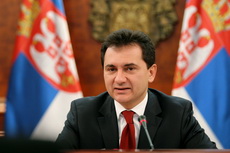
In a statement to Tanjug news agency, Djelic said that developed countries are looking at increased funding for sciences as a possible way out of the crisis, and the best Serbian scientists could be targeted by them.
The Minister said that additional sources of funding must be secured because allocations from the budget were not increased once during the previous few years, adding that because of the economic crisis an increase is not even to be expected next year. He said that his Ministry has negotiated with donors and international financial institutions, adding that the European Investment Bank has approved negotiations concerning a €150 million loan for investment in science.
He said that €25 million was secured through the EU’s IPA programme for 2010, to which additions will be made from the budget. He explained that other international organisations and donors were contacted as well and it is expected that a sum of nearly €300 million will be invested in science and technology over a five year period. These will be the largest investments in science ever made in Serbia, stressed Djelic, adding that the €300 million sum will make it possible for Serbia to gain prestige in Europe in the field of science and technology. The Minister said that the funds will be used to build a new campus for technology related faculties in Belgrade and a centre for the popularisation of science and technology.
He said that funds are also intended for building infrastructure at the Petnica Research Centre, a new campus for the Belgrade School of Mathematics, for the renovation of the buildings of the faculties of mathematics and chemistry and for the construction of a campus for the Faculty of Biomedical Sciences. Djelic said that the funds will also be used to build flats for scientists and researchers in Belgrade, Novi Sad, Nis and Kragujevac. He stressed that the national strategy for the development of science and technology aims at creating conditions which will make Serbia a country with a knowledge-based economy. In order to achieve this goal we must confront a few harsh realities, we have partially lost our human resource potential, according to international standards we invest very little in science and the funds are not used well, said Djelic. The Minister said that the allocation for science in Serbia stands at 0.3% GDP, stressing that the Serbian economy invests very little in technology. Djelic said that Serbia cannot reach its goal alone and partnerships must be formed with domestic and international scientific institutions and technology companies.
He said that according to the national strategy the focus will be on seven areas, biomedicine, energy, agriculture and food, information and communication technology, new materials and nanoscience, environmental protection and climate change and improving decision making at the state level and the affirmation of national identity. Speaking about financial support for talented people in Serbia and national awards, Djelic said that the financial support is there but it is far more important to establish a system which will offer a suitable environment for the development of talent.
The Minister said that additional sources of funding must be secured because allocations from the budget were not increased once during the previous few years, adding that because of the economic crisis an increase is not even to be expected next year. He said that his Ministry has negotiated with donors and international financial institutions, adding that the European Investment Bank has approved negotiations concerning a €150 million loan for investment in science.
He said that €25 million was secured through the EU’s IPA programme for 2010, to which additions will be made from the budget. He explained that other international organisations and donors were contacted as well and it is expected that a sum of nearly €300 million will be invested in science and technology over a five year period. These will be the largest investments in science ever made in Serbia, stressed Djelic, adding that the €300 million sum will make it possible for Serbia to gain prestige in Europe in the field of science and technology. The Minister said that the funds will be used to build a new campus for technology related faculties in Belgrade and a centre for the popularisation of science and technology.
He said that funds are also intended for building infrastructure at the Petnica Research Centre, a new campus for the Belgrade School of Mathematics, for the renovation of the buildings of the faculties of mathematics and chemistry and for the construction of a campus for the Faculty of Biomedical Sciences. Djelic said that the funds will also be used to build flats for scientists and researchers in Belgrade, Novi Sad, Nis and Kragujevac. He stressed that the national strategy for the development of science and technology aims at creating conditions which will make Serbia a country with a knowledge-based economy. In order to achieve this goal we must confront a few harsh realities, we have partially lost our human resource potential, according to international standards we invest very little in science and the funds are not used well, said Djelic. The Minister said that the allocation for science in Serbia stands at 0.3% GDP, stressing that the Serbian economy invests very little in technology. Djelic said that Serbia cannot reach its goal alone and partnerships must be formed with domestic and international scientific institutions and technology companies.
He said that according to the national strategy the focus will be on seven areas, biomedicine, energy, agriculture and food, information and communication technology, new materials and nanoscience, environmental protection and climate change and improving decision making at the state level and the affirmation of national identity. Speaking about financial support for talented people in Serbia and national awards, Djelic said that the financial support is there but it is far more important to establish a system which will offer a suitable environment for the development of talent.
-
 Belgrade, 24 July 2026
Serbia, Hungary partners in addressing regional security challenges
-
 Belgrade, 24 July 2026
Dačić congratulates UK Home Secretary on reappointment
-
 Belgrade, 22 July 2026
Serbia follows modern technological achievements, attracts investments
-
 Belgrade, 22 July 2026
Continued cooperation with Russia in field of security, emergency situations
-
 Belgrade, 22 July 2026
New opportunities for expanding economic cooperation between Serbia, China
-
 Belgrade, 20 July 2026
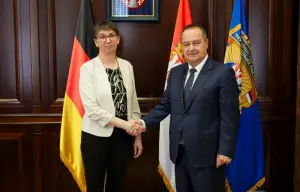
Cooperation in field of interior affairs important segment of relations with Germany
-
 Belgrade, 16 July 2026
Expo 2027 opportunity to further strengthen international partnerships
-
 Belgrade/Bratislava, 16 July 2026
Serbia, Slovakia continue to strengthen political, economic cooperation
-
 Belgrade, 14 July 2026
Serbia bilaterally resolves problems arising from EES implementation
-
 Gradina/Kalotina, 9 July 2026
Improving border cooperation between Serbia, Bulgaria