
Q:
A:
Serbia to undertake technical requirements of visa liberalisation
Belgrade,
16 July 2009
Deputy Prime Minister for EU Integration Bozidar Djelic today stated that at the European Commission’s recommendation the government will adopt a national strategy for migration management and an action plan for suppressing organised crime by October 1.

Author:
www.rts.rs
Talking about the European Commission’s proposal on visa liberalisation for Serbian citizens as of January 1, 2010, Djelic explained that Serbia is currently working on meeting technical preconditions necessary for visa liberalisation.
Appearing on RTS he specified that Serbia must adopt the action plan for suppressing organised crime and drug trafficking and an operating agreement with EULEX, adding that the law on foreigners, which was adopted in April, must be consistently implemented.
The Minister announced that the European Commission’s technical mission will visit Serbia in September to ensure that Serbia is really working on meeting visa liberalisation criteria.
The European Commission has presented the Serbian government with a draft law envisaging the removal of visa restrictions for Serbian citizens as of January 1, 2010, he said.
Djelic recalled that 830,000 new biometric passports have been issued to date and called upon Serbian citizens to apply for new passports as soon as possible, as the old ones will be invalid from the beginning of next year.
The Minister stressed that speculation that the European Commission’s decision indirectly implies the recognition of Kosovo independence is ungrounded.
Djelic explained that according to Resolution 1244, Kosovo is treated as a territory under the international community’s administration, adding that this decision was made without prejudging the province’s final status. He also noted that Belgrade will be consulted on further issues regarding visa liberalisation.
He said the European Commission’s decision is an important acknowledgment to Serbia, adding that 84% of Serbian citizens think that the white Schengen is important for the country and 49% believes it is important to both themselves young people and the Serbian economy.
As for how much closer Serbia is to EU membership, Djelic said that the white Schengen is an overall grade of the country’s security and stability and proof that Serbia is a serious country, fighting corruption and organised crime at every step.
He said that at today’s session the government will discuss the action plan for EU integration, including the parts related to the white Schengen.
Speaking about EU integration, Djelic said that in the last quarter Serbia fulfilled 50% of the required terms, which now amounts to 70% overall, voicing his expectation that the next step will be to attract low-cost airlines to Serbia.
Now that visas are no longer necessary our citizens will be able to travel to all EU countries except for the UK and Ireland, because they are not members of the Schengen, and Switzerland, Norway and Iceland.
Our citizens will be able to stay in these countries for up to 90 days, but visa abolishment does not mean they will have the right to work there, explained Djelic, adding that Serbia’s next steps will go in that direction.
Appearing on RTS he specified that Serbia must adopt the action plan for suppressing organised crime and drug trafficking and an operating agreement with EULEX, adding that the law on foreigners, which was adopted in April, must be consistently implemented.
The Minister announced that the European Commission’s technical mission will visit Serbia in September to ensure that Serbia is really working on meeting visa liberalisation criteria.
The European Commission has presented the Serbian government with a draft law envisaging the removal of visa restrictions for Serbian citizens as of January 1, 2010, he said.
Djelic recalled that 830,000 new biometric passports have been issued to date and called upon Serbian citizens to apply for new passports as soon as possible, as the old ones will be invalid from the beginning of next year.
The Minister stressed that speculation that the European Commission’s decision indirectly implies the recognition of Kosovo independence is ungrounded.
Djelic explained that according to Resolution 1244, Kosovo is treated as a territory under the international community’s administration, adding that this decision was made without prejudging the province’s final status. He also noted that Belgrade will be consulted on further issues regarding visa liberalisation.
He said the European Commission’s decision is an important acknowledgment to Serbia, adding that 84% of Serbian citizens think that the white Schengen is important for the country and 49% believes it is important to both themselves young people and the Serbian economy.
As for how much closer Serbia is to EU membership, Djelic said that the white Schengen is an overall grade of the country’s security and stability and proof that Serbia is a serious country, fighting corruption and organised crime at every step.
He said that at today’s session the government will discuss the action plan for EU integration, including the parts related to the white Schengen.
Speaking about EU integration, Djelic said that in the last quarter Serbia fulfilled 50% of the required terms, which now amounts to 70% overall, voicing his expectation that the next step will be to attract low-cost airlines to Serbia.
Now that visas are no longer necessary our citizens will be able to travel to all EU countries except for the UK and Ireland, because they are not members of the Schengen, and Switzerland, Norway and Iceland.
Our citizens will be able to stay in these countries for up to 90 days, but visa abolishment does not mean they will have the right to work there, explained Djelic, adding that Serbia’s next steps will go in that direction.

-
 Belgrade, 24 July 2026
Serbia, Hungary partners in addressing regional security challenges
-
 Belgrade, 24 July 2026
Dačić congratulates UK Home Secretary on reappointment
-
 Belgrade, 22 July 2026
Serbia follows modern technological achievements, attracts investments
-
 Belgrade, 22 July 2026
Continued cooperation with Russia in field of security, emergency situations
-
 Belgrade, 22 July 2026
New opportunities for expanding economic cooperation between Serbia, China
-
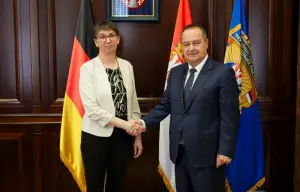 Belgrade, 20 July 2026
Cooperation in field of interior affairs important segment of relations with Germany
-
 Belgrade, 16 July 2026
Expo 2027 opportunity to further strengthen international partnerships
-
 Belgrade/Bratislava, 16 July 2026
Serbia, Slovakia continue to strengthen political, economic cooperation
-
 Belgrade, 14 July 2026
Serbia bilaterally resolves problems arising from EES implementation
-
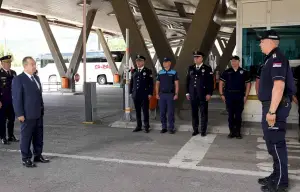 Gradina/Kalotina, 9 July 2026
Improving border cooperation between Serbia, Bulgaria