
Q:
A:
Serbia, Russia sign agreement on nuclear waste export
Belgrade,
10 June 2009
Deputy Prime Minister for EU Integration and Minister of Science and Technological Development Bozidar Djelic signed today an agreement concerning cooperation with the Russian government for exporting nuclear fuel to a research reactor in Russia with Director General of the Rosatom State Nuclear Energy Corporation Sergey Kiriyenko.
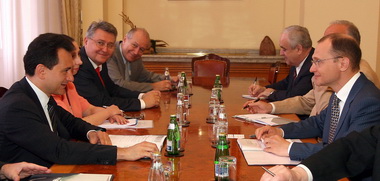
Djelic said that the agreement, concerning the export of nuclear fuel from the Vinca Institute of Nuclear Sciences to Russia, will help Serbia reduce the threat of nuclear terrorism, adding that it is of great importance for Serbia’s EU integration and international cooperation in general.
Kiriyenko pointed out that according to the agreement around 3 tonnes of nuclear waste containing highly enriched uranium will be imported from Serbia.
He explained that it would be too complicated to use nuclear waste for the production of nuclear weapons but some terrorist organisation could certainly make use of it.
The route to Russia for the transport of the nuclear waste has been mapped, he said, adding that this July the equipment necessary for transportation will be installed and staff trained to handle it.
Kiriyenko voiced his belief that the nuclear waste will most likely be transferred into containers this autumn.
Djelic specified that the entire project will cost $54 million, adding that $25 million still needs to be procured and Serbia will secure $10 million from the budget.
We have found resources for the remaining $15 million, but we have to find another $9.2 million for the compensation for permanent storage of nuclear waste, he noted.
The agreement signed today has opened the door for a more detailed trade agreement which will specify the details of the arrangement, as well as possibilities for further cooperation, primarily in the exchange of knowledge when it comes to applying nuclear technologies for peaceful purposes.
Kiriyenko pointed out that according to the agreement around 3 tonnes of nuclear waste containing highly enriched uranium will be imported from Serbia.
He explained that it would be too complicated to use nuclear waste for the production of nuclear weapons but some terrorist organisation could certainly make use of it.
The route to Russia for the transport of the nuclear waste has been mapped, he said, adding that this July the equipment necessary for transportation will be installed and staff trained to handle it.
Kiriyenko voiced his belief that the nuclear waste will most likely be transferred into containers this autumn.
Djelic specified that the entire project will cost $54 million, adding that $25 million still needs to be procured and Serbia will secure $10 million from the budget.
We have found resources for the remaining $15 million, but we have to find another $9.2 million for the compensation for permanent storage of nuclear waste, he noted.
The agreement signed today has opened the door for a more detailed trade agreement which will specify the details of the arrangement, as well as possibilities for further cooperation, primarily in the exchange of knowledge when it comes to applying nuclear technologies for peaceful purposes.
-
 Belgrade, 24 July 2026
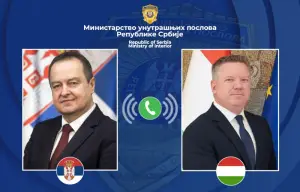
Serbia, Hungary partners in addressing regional security challenges
-
 Belgrade, 24 July 2026
Dačić congratulates UK Home Secretary on reappointment
-
 Belgrade, 22 July 2026
Serbia follows modern technological achievements, attracts investments
-
 Belgrade, 22 July 2026
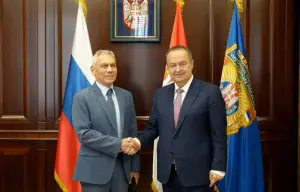
Continued cooperation with Russia in field of security, emergency situations
-
 Belgrade, 22 July 2026
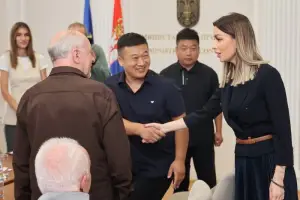
New opportunities for expanding economic cooperation between Serbia, China
-
 Belgrade, 20 July 2026
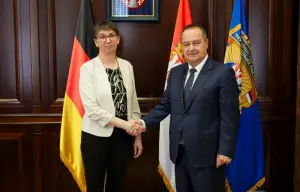
Cooperation in field of interior affairs important segment of relations with Germany
-
 Belgrade, 16 July 2026
Expo 2027 opportunity to further strengthen international partnerships
-
 Belgrade/Bratislava, 16 July 2026
Serbia, Slovakia continue to strengthen political, economic cooperation
-
 Belgrade, 14 July 2026
Serbia bilaterally resolves problems arising from EES implementation
-
 Gradina/Kalotina, 9 July 2026
Improving border cooperation between Serbia, Bulgaria