
Q:
A:
Agreement on EIB loan for SMEs to be signed on May 11
Belgrade,
9 May 2009
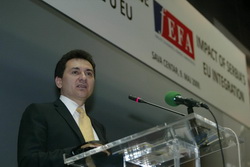
Deputy Prime Minister for EU integration Bozidar Djelic today announced that on May 11 an agreement will be signed on a €250 million loan from the European Investment Bank (EIB) intended for Serbian SMEs.
Author:
Fonet
Speaking at a conference “Effects of EU Integration in Serbia” taking place at the Sava Centre on occasion of the Europe Day, Djelic announced that in the period 2000–2011 Serbia will have received around €3 billion of non-refundable aid from EU IPA funds, adding that the EU is undoubtedly Serbia’s greatest donor.
He said 80% of funds for Corridor 10 come from the EU, that is, the European Commission, EIB and the European Bank for Reconstruction and Development.
He recalled that yesterday EU Enlargement Commissioner Olli Rehn informed him that the European Commission decided to grant Serbia non-refundable budget aid of around €100 million.
Djelic announced that before the year’s end Serbia will apply for EU membership, recalling that it is already implementing an agreement with the EU with the loss from the abolishment and reduction of customs tax amounting to €5 million a month.
The EU opened its market to Serbian products in 2000 and thanks to that in 2008 our goods were relieved of customs tax of €35 million a month, he said.
Our gain from the EU integration process is much higher than our loss, said Djelic adding that 55% of Serbia’s trade is with EU countries and 80% of direct investments come from the EU.
The Deputy Prime Minister voiced his belief that the report of the Hague tribunal Chief Prosecutor Serge Brammertz on Serbia’s cooperation will be positive and serve as a basis for the implementation of the Stabilisation and Association Agreement (SAA) with the EU.
Serbia is doing all it can to conclude cooperation with the tribunal, reiterated Djelic adding that the Serbian government is working on bringing round all EU members to vote for SAA implementation.
He said that the condition for the continuation of Serbia’s integration process is the arrest of the two remaining Hague indictees.
As for visa liberalisation, Djelic voiced his belief that the European Commission and the Council of Ministers will declare their stance in June and that in autumn a report will be sent to the European Parliament, which is to give its opinion on this matter.
Djelic also announced that by the year’s end the Council of Ministers is to decide on abolishing visas for Serbian citizens.
Head of the European Commission delegation to Belgrade Josep Lloveras stressed the necessity of the continuation of Serbia’s reforms despite the crisis.
He also emphasised that the economic crisis showed that not a single state can solve issues alone, adding that a global crisis requires global solutions and EU integration is an efficacious response to the crisis.
According to him the EU did not leave Serbia to face the crisis on its own, but granted it budget assistance of €100 million from IPA funds.
He said 80% of funds for Corridor 10 come from the EU, that is, the European Commission, EIB and the European Bank for Reconstruction and Development.
He recalled that yesterday EU Enlargement Commissioner Olli Rehn informed him that the European Commission decided to grant Serbia non-refundable budget aid of around €100 million.
Djelic announced that before the year’s end Serbia will apply for EU membership, recalling that it is already implementing an agreement with the EU with the loss from the abolishment and reduction of customs tax amounting to €5 million a month.
The EU opened its market to Serbian products in 2000 and thanks to that in 2008 our goods were relieved of customs tax of €35 million a month, he said.
Our gain from the EU integration process is much higher than our loss, said Djelic adding that 55% of Serbia’s trade is with EU countries and 80% of direct investments come from the EU.
The Deputy Prime Minister voiced his belief that the report of the Hague tribunal Chief Prosecutor Serge Brammertz on Serbia’s cooperation will be positive and serve as a basis for the implementation of the Stabilisation and Association Agreement (SAA) with the EU.
Serbia is doing all it can to conclude cooperation with the tribunal, reiterated Djelic adding that the Serbian government is working on bringing round all EU members to vote for SAA implementation.
He said that the condition for the continuation of Serbia’s integration process is the arrest of the two remaining Hague indictees.
As for visa liberalisation, Djelic voiced his belief that the European Commission and the Council of Ministers will declare their stance in June and that in autumn a report will be sent to the European Parliament, which is to give its opinion on this matter.
Djelic also announced that by the year’s end the Council of Ministers is to decide on abolishing visas for Serbian citizens.
Head of the European Commission delegation to Belgrade Josep Lloveras stressed the necessity of the continuation of Serbia’s reforms despite the crisis.
He also emphasised that the economic crisis showed that not a single state can solve issues alone, adding that a global crisis requires global solutions and EU integration is an efficacious response to the crisis.
According to him the EU did not leave Serbia to face the crisis on its own, but granted it budget assistance of €100 million from IPA funds.
-
 Belgrade, 24 July 2026
Serbia, Hungary partners in addressing regional security challenges
-
 Belgrade, 24 July 2026
Dačić congratulates UK Home Secretary on reappointment
-
 Belgrade, 22 July 2026
Serbia follows modern technological achievements, attracts investments
-
 Belgrade, 22 July 2026
Continued cooperation with Russia in field of security, emergency situations
-
 Belgrade, 22 July 2026
New opportunities for expanding economic cooperation between Serbia, China
-
 Belgrade, 20 July 2026
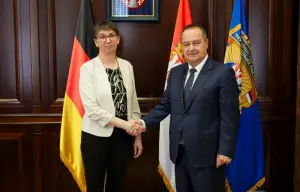
Cooperation in field of interior affairs important segment of relations with Germany
-
 Belgrade, 16 July 2026
Expo 2027 opportunity to further strengthen international partnerships
-
 Belgrade/Bratislava, 16 July 2026
Serbia, Slovakia continue to strengthen political, economic cooperation
-
 Belgrade, 14 July 2026
Serbia bilaterally resolves problems arising from EES implementation
-
 Gradina/Kalotina, 9 July 2026
Improving border cooperation between Serbia, Bulgaria