
Q:
A:
Agreement on €168m of IPA funds for 2008 signed
Valjevo,
1 April 2009
Deputy Prime Minister for EU Integration Bozidar Djelic and Head of the European Commission delegation to Serbia Josep Lloveras signed in Valjevo today an agreement on using funds from the IPA programme for 2008, to the amount of €168 million.
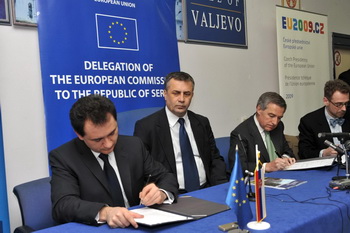
Author:
Fonet
Following the signing Djelic explained that this is simply another tranche of the total €1 billion of non-refundable aid which the EU set aside for Serbia for the period 2007–2012 for implementing reforms regarding Serbia’s EU integration process.
He said the funds will be used to finance 36 projects from different areas, ensuring a better future for Serbian citizens, adding that the largest portion of €45 million will go to local self-government.
He recalled that the European Commission stated in Brussels recently that it is contemplating the third tranche to Serbia from the IPA funds for 2009, intended for budget support, adding that the EU thus aims to endorse Serbia’s EU integration process.
Lloveras noted that the agreement signed today is a strong sign of EU’s support for Serbia’s EU integration reforms, adding that the non-refundable aid is intended to develop and strengthen democracy in Serbia, facilitate the implementation of EU standards and strengthen the state.
He recalled that the European Commission has already earmarked more than €2 billion for Serbia through various donations and loans.
According to him European Commissioners Olli Rehn and Roberto Almunia are considering the possibility that IPA funds be set aside as support for the Serbian budget, although such funds are usually not allocated for such purposes.
Lloveras noted that 22 EU ambassadors accredited to Belgrade were present during the signing of the agreement, which is a clear sign that the EU supports Serbia’s reforms.
The event was also attended by Director of the government’s EU Integration Office Milica Delevic.
He said the funds will be used to finance 36 projects from different areas, ensuring a better future for Serbian citizens, adding that the largest portion of €45 million will go to local self-government.
He recalled that the European Commission stated in Brussels recently that it is contemplating the third tranche to Serbia from the IPA funds for 2009, intended for budget support, adding that the EU thus aims to endorse Serbia’s EU integration process.
Lloveras noted that the agreement signed today is a strong sign of EU’s support for Serbia’s EU integration reforms, adding that the non-refundable aid is intended to develop and strengthen democracy in Serbia, facilitate the implementation of EU standards and strengthen the state.
He recalled that the European Commission has already earmarked more than €2 billion for Serbia through various donations and loans.
According to him European Commissioners Olli Rehn and Roberto Almunia are considering the possibility that IPA funds be set aside as support for the Serbian budget, although such funds are usually not allocated for such purposes.
Lloveras noted that 22 EU ambassadors accredited to Belgrade were present during the signing of the agreement, which is a clear sign that the EU supports Serbia’s reforms.
The event was also attended by Director of the government’s EU Integration Office Milica Delevic.
The Serbian Deputy Prime Minister and Minister of Science and Technological Development, accompanied by ambassadors from EU countries, today visited the Petnica research centre where the director and students at the centre informed them about their work and activities.
Djelic said at the occasion that the research centre was established more than 25 years ago and thousands of researchers and young scientists from Serbia and abroad have studied and worked there.
He said that because of the global economic crisis there is a lack of funds for research and scientific work, particularly at the Vinca nuclear institute and Petnica, adding that the idea of obtaining loans for investment in the sciences from the European Bank for Reconstruction and Development and the World Bank is under consideration.
Djelic told the EU ambassadors about the project for building another facility at the Petnica research centre, which began in 1966 but was halted because no more funds were available.
Lloveras said that €4 million of the €168 million from IPA programme funds approved to Serbia will be spent on financing research work in various institutes.
He said that despite the financial crisis the EU attaches great importance to the development of science and technology because without it we cannot count on dealing with the crisis.
Djelic said at the occasion that the research centre was established more than 25 years ago and thousands of researchers and young scientists from Serbia and abroad have studied and worked there.
He said that because of the global economic crisis there is a lack of funds for research and scientific work, particularly at the Vinca nuclear institute and Petnica, adding that the idea of obtaining loans for investment in the sciences from the European Bank for Reconstruction and Development and the World Bank is under consideration.
Djelic told the EU ambassadors about the project for building another facility at the Petnica research centre, which began in 1966 but was halted because no more funds were available.
Lloveras said that €4 million of the €168 million from IPA programme funds approved to Serbia will be spent on financing research work in various institutes.
He said that despite the financial crisis the EU attaches great importance to the development of science and technology because without it we cannot count on dealing with the crisis.
-
 Belgrade, 24 July 2026
Dačić congratulates UK Home Secretary on reappointment
-
 Belgrade, 22 July 2026
Serbia follows modern technological achievements, attracts investments
-
 Belgrade, 22 July 2026
Continued cooperation with Russia in field of security, emergency situations
-
 Belgrade, 22 July 2026
New opportunities for expanding economic cooperation between Serbia, China
-
 Belgrade, 20 July 2026
Cooperation in field of interior affairs important segment of relations with Germany
-
 Belgrade, 16 July 2026
Expo 2027 opportunity to further strengthen international partnerships
-
 Belgrade/Bratislava, 16 July 2026
Serbia, Slovakia continue to strengthen political, economic cooperation
-
 Belgrade, 14 July 2026
Serbia bilaterally resolves problems arising from EES implementation
-
 Gradina/Kalotina, 9 July 2026
Improving border cooperation between Serbia, Bulgaria
-
 Belgrade, 7 July 2026
Further strengthening economic cooperation between Serbia, Italy