
Q:
A:
EU support for dealing with financial crisis must include Serbia, Western Balkans
Belgrade/Brussels,
24 March 2009
Serbian Deputy Prime Minister for EU integration Bozidar Djelic said today in Brussels that only Serbia and the Western Balkans are paying the full price of having to deal with the effects of the global financial crisis.
In a lecture and debate titled “Is the Western Balkans region inside or outside the EU”, held at the European Policy Centre in Brussels, Djelic said that new EU members which are experiencing financial difficulties have easy access to large funds.
He said that the EU has reached agreement with Ukraine to invest huge funds in the system for supplying Russian gas to Europe while Serbia and Western Balkan states were badly affected by the gas crisis this year, adding that these countries are implementing European reforms but have received no funds for enlarging gas storage facilities and pipelines.
He said that the EU has decided that the remaining funds of €5 billion from earlier years should mainly be invested in energy infrastructure, while there are no plans to provide financial assistance to the Western Balkans states even though they are members of the Energy Community.
Djelic said that the Serbian government proposes that half of Serbia’s budget deficit, caused by the financial crisis, which the IMF thinks could reach 6% of the GDP, should be dealt with by the government and the rest mostly by international banks and institutions.
He said that this includes also the proposal being examined by the European Commission that €120 million should be set aside from the IPA programme for supporting candidate countries and potential candidate countries in the Balkans.
Part of the debt would be covered from expected privatisation revenues and loans so that the government would provide €900 million, while the same amount should be provided from international financial institutions, including private European banks in Serbia which so far have made substantial profits, Djelic explained.
He added that the government expects those banks from the euro zone operating in Serbia to postpone pending debts of Serbian companies to the amount of nearly €5 billion.
The banking system in Serbia today is one of the most successful in Europe, Djelic said, noting that the disposable capital in Serbian banks is three times larger than in Hungary.
Two-thirds of Serbia’s trade is with the EU, while the rest is within the region, Djelic said, adding that 75% of investment, or €10 billion, in the past three years came from the EU.
Factually, but not legally, Serbia is already part of the EU, Djelic said, noting that therefore every package in support of countries in difficulty must include Serbia and the Western Balkans.
He said that the EU has reached agreement with Ukraine to invest huge funds in the system for supplying Russian gas to Europe while Serbia and Western Balkan states were badly affected by the gas crisis this year, adding that these countries are implementing European reforms but have received no funds for enlarging gas storage facilities and pipelines.
He said that the EU has decided that the remaining funds of €5 billion from earlier years should mainly be invested in energy infrastructure, while there are no plans to provide financial assistance to the Western Balkans states even though they are members of the Energy Community.
Djelic said that the Serbian government proposes that half of Serbia’s budget deficit, caused by the financial crisis, which the IMF thinks could reach 6% of the GDP, should be dealt with by the government and the rest mostly by international banks and institutions.
He said that this includes also the proposal being examined by the European Commission that €120 million should be set aside from the IPA programme for supporting candidate countries and potential candidate countries in the Balkans.
Part of the debt would be covered from expected privatisation revenues and loans so that the government would provide €900 million, while the same amount should be provided from international financial institutions, including private European banks in Serbia which so far have made substantial profits, Djelic explained.
He added that the government expects those banks from the euro zone operating in Serbia to postpone pending debts of Serbian companies to the amount of nearly €5 billion.
The banking system in Serbia today is one of the most successful in Europe, Djelic said, noting that the disposable capital in Serbian banks is three times larger than in Hungary.
Two-thirds of Serbia’s trade is with the EU, while the rest is within the region, Djelic said, adding that 75% of investment, or €10 billion, in the past three years came from the EU.
Factually, but not legally, Serbia is already part of the EU, Djelic said, noting that therefore every package in support of countries in difficulty must include Serbia and the Western Balkans.
-
 Belgrade, 24 July 2026
Dačić congratulates UK Home Secretary on reappointment
-
 Belgrade, 22 July 2026
Serbia follows modern technological achievements, attracts investments
-
 Belgrade, 22 July 2026
Continued cooperation with Russia in field of security, emergency situations
-
 Belgrade, 22 July 2026
New opportunities for expanding economic cooperation between Serbia, China
-
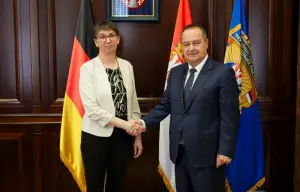 Belgrade, 20 July 2026
Cooperation in field of interior affairs important segment of relations with Germany
-
 Belgrade, 16 July 2026
Expo 2027 opportunity to further strengthen international partnerships
-
 Belgrade/Bratislava, 16 July 2026
Serbia, Slovakia continue to strengthen political, economic cooperation
-
 Belgrade, 14 July 2026
Serbia bilaterally resolves problems arising from EES implementation
-
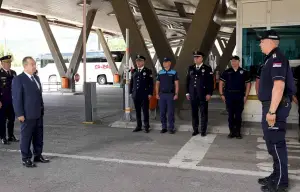 Gradina/Kalotina, 9 July 2026
Improving border cooperation between Serbia, Bulgaria
-
 Belgrade, 7 July 2026
Further strengthening economic cooperation between Serbia, Italy