
Q:
A:
Serbia to use geographical position for economic development
Belgrade,
6 March 2009
Deputy Prime Minister Bozidar Djelic said that in the future Serbia will use its geographical position for speedier economic development.
At the presentation of the World Bank’s report “Change of Economic Geography”, Djelic said that the World Bank has recognised geographical position as an important factor for development, adding that Serbia’s favourable geographical position will therefore speed up its economic development.
Regardless of its favourable geographical position, the global financial crisis will slow down Serbia’s development as it primarily depends on the EU market, which is having difficulties.
According to Djelic the World Bank’s report clearly shows that all countries which have not made use of their geographical position have huge regional differences.
The Minister said that Belgrade, Vojvodina and central Serbia’s GDP has been leveled in the overall GDP, but one third of Serbia’s income is coming from 4.2 % of the territory, i.e. from Belgrade.
This feature of transition is not necessarily a negative one, stressed Djelic, but he warned that there is a risk that as the economic and trade concentration increases the regional gap becomes even deeper.
He stressed that this is why the country must be linked to the region and the world, adding that Corridor 10 is a developmental opportunity in which around €3.3 billion is to be invested over the next three years.
Apart from that, around €3 billion is needed for the motorway from Belgrade to the South Adriatic, said Djelic, recalling that the fact that Serbia is a landlocked country without access to the sea can have a negative effect on speedier development, which is also evident from the Security Council’s report.
Djelic explained that the alternative is the Danube River, that is, Corridor 7, which leads to Konstanz on the Black Sea, as well as the development of roads towards Bar in Montenegro and the Adriatic Sea and Corridor 10 to Thessaloniki and the Aegean Sea, on which Serbia must still work hard.
Regardless of its favourable geographical position, the global financial crisis will slow down Serbia’s development as it primarily depends on the EU market, which is having difficulties.
According to Djelic the World Bank’s report clearly shows that all countries which have not made use of their geographical position have huge regional differences.
The Minister said that Belgrade, Vojvodina and central Serbia’s GDP has been leveled in the overall GDP, but one third of Serbia’s income is coming from 4.2 % of the territory, i.e. from Belgrade.
This feature of transition is not necessarily a negative one, stressed Djelic, but he warned that there is a risk that as the economic and trade concentration increases the regional gap becomes even deeper.
He stressed that this is why the country must be linked to the region and the world, adding that Corridor 10 is a developmental opportunity in which around €3.3 billion is to be invested over the next three years.
Apart from that, around €3 billion is needed for the motorway from Belgrade to the South Adriatic, said Djelic, recalling that the fact that Serbia is a landlocked country without access to the sea can have a negative effect on speedier development, which is also evident from the Security Council’s report.
Djelic explained that the alternative is the Danube River, that is, Corridor 7, which leads to Konstanz on the Black Sea, as well as the development of roads towards Bar in Montenegro and the Adriatic Sea and Corridor 10 to Thessaloniki and the Aegean Sea, on which Serbia must still work hard.
-
 Belgrade, 24 July 2026
Dačić congratulates UK Home Secretary on reappointment
-
 Belgrade, 22 July 2026
Serbia follows modern technological achievements, attracts investments
-
 Belgrade, 22 July 2026
Continued cooperation with Russia in field of security, emergency situations
-
 Belgrade, 22 July 2026
New opportunities for expanding economic cooperation between Serbia, China
-
 Belgrade, 20 July 2026
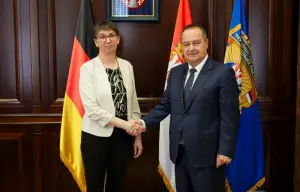
Cooperation in field of interior affairs important segment of relations with Germany
-
 Belgrade, 16 July 2026
Expo 2027 opportunity to further strengthen international partnerships
-
 Belgrade/Bratislava, 16 July 2026
Serbia, Slovakia continue to strengthen political, economic cooperation
-
 Belgrade, 14 July 2026
Serbia bilaterally resolves problems arising from EES implementation
-
 Gradina/Kalotina, 9 July 2026
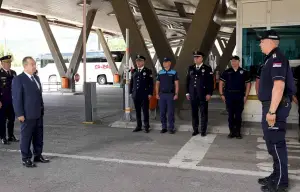
Improving border cooperation between Serbia, Bulgaria
-
 Belgrade, 7 July 2026
Further strengthening economic cooperation between Serbia, Italy