
Q:
A:
6th ministerial conference on South East Europe border security cooperation
Belgrade,
5 March 2009
First Deputy Prime Minister and Minister of Interior Ivica Dacic today stated that the government’s priority is cooperation with neighbouring countries and the joint fight against organised and cross-border crime.
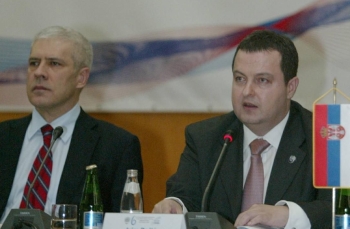
Boris Tadic, left, and Ivica Dacic
Author:
Fonet
At the opening of the 6th ministerial conference on South East Europe border security cooperation, Dacic said that the government also aims to exchange experiences with neighbouring countries concerning the EU integration process.
He stressed that Serbia is making efforts to develop good relations with other countries and provide security in the region, adding that the cooperation regarding border security is a main precondition for good relations in the region.
Since the last conference, held in February 2008 in Budva,Montenegro, Serbia has made considerable progress in this respect, said the Minister, adding that the best proof for that is the current process of visa liberalisation.
Regional cooperation is the main precondition for integrated border management and the fight against illegal migration, corruption and organised crime, stressed Minister Dacic.
He stressed that Serbia is completely ready for regional cooperation, adding that he is convinced that the people of the region will soon be able to travel freely within Europe.
I think that current initiatives for strengthening the mechanisms and capabilities for international police cooperation through direct bilateral contacts and international cooperation agreements are extremely important, said the Deputy Prime Minister.
Serbian President Boris Tadic addressed the participants to announce that the government will initiate the most comprehensive fight against organised crime ever.
Tadic pointed out that Serbia will engage all its resources, adding that neighbouring countries must do the same.
South Eastern Europe’s fight against crime is not possible without EU assistance.
Serbia’s goals are to fight against crime, provide better infrastructure and above all achieve the rule of law. When we reach all these aims we want to become EU members, said Tadic.
The Serbian President said that South Eastern Europe is currently in political and economic transition and therefore it is making efforts to achieve the rule of law and EU standards.
Tadic explained that the region will soon face huge reforms, including the reform of the value systems of citizens and state institutions.
All countries in the region will have to jointly fight against organised crime, implement reforms and set up new value systems, he said. Czech Minister of Interior Ivan Langer said that security system reforms are of major importance for EU future of Western Balkan countries. Langer stressed that the EU highly appreciates their efforts to strengthen cross-border cooperation, since all of them will once be part of one community.
He pointed out that the Czech Republic, currently presiding over the EU, pays special attention to visa liberalisation of Western Balkan countries, saying that the EU is satisfied with its mission’s report concerning the situation in Serbia.
Deputy Director General of the European Commission’s Directorate General for Enlargement Jan Truszczynski said that the European Commission expects visa liberalisation of the Western Balkans to be achieved as soon as possible.
He noted that the European Commission will continue providing help to countries in the region regarding the fight against organised crime, particularly by deploying the European Agency for the Management of Operational Cooperation at the External Borders (FRONTEX).
Director of the Geneva Centre for the Democratic Control of Armed Forces (DCAF) Theodore Winkler, who organised this conference together with the Serbian Interior Minister, said that the Western Balkans have achieved a lot when it comes to cross-border cooperation, but it still has to do much more.
Bulgarian and Italian Interior Ministers Mihail Mikov and Roberto Maroni addressed the conference to convey a message that the Balkans is of great strategic importance and that they will continue supporting this region in its fight against organised crime, particularly drug trafficking. Interior ministers from Serbia, Albania, Bosnia-Herzegovina, Croatia, Macedonia, Montenegro, Austria, Slovenia and the Czech Republic are taking part in the three day conference, organised by the DCAF.
They will discuss the results achieved in their respective countries concerning the key aims defined in the 2006 Ministerial Declaration.
The delegations will also present reports on their achievements in the area of integrated border management during the previous year and discuss the implementation of strategies for the 2009-2011 period.
He stressed that Serbia is making efforts to develop good relations with other countries and provide security in the region, adding that the cooperation regarding border security is a main precondition for good relations in the region.
Since the last conference, held in February 2008 in Budva,Montenegro, Serbia has made considerable progress in this respect, said the Minister, adding that the best proof for that is the current process of visa liberalisation.
Regional cooperation is the main precondition for integrated border management and the fight against illegal migration, corruption and organised crime, stressed Minister Dacic.
He stressed that Serbia is completely ready for regional cooperation, adding that he is convinced that the people of the region will soon be able to travel freely within Europe.
I think that current initiatives for strengthening the mechanisms and capabilities for international police cooperation through direct bilateral contacts and international cooperation agreements are extremely important, said the Deputy Prime Minister.
Serbian President Boris Tadic addressed the participants to announce that the government will initiate the most comprehensive fight against organised crime ever.
Tadic pointed out that Serbia will engage all its resources, adding that neighbouring countries must do the same.
South Eastern Europe’s fight against crime is not possible without EU assistance.
Serbia’s goals are to fight against crime, provide better infrastructure and above all achieve the rule of law. When we reach all these aims we want to become EU members, said Tadic.
The Serbian President said that South Eastern Europe is currently in political and economic transition and therefore it is making efforts to achieve the rule of law and EU standards.
Tadic explained that the region will soon face huge reforms, including the reform of the value systems of citizens and state institutions.
All countries in the region will have to jointly fight against organised crime, implement reforms and set up new value systems, he said. Czech Minister of Interior Ivan Langer said that security system reforms are of major importance for EU future of Western Balkan countries. Langer stressed that the EU highly appreciates their efforts to strengthen cross-border cooperation, since all of them will once be part of one community.
He pointed out that the Czech Republic, currently presiding over the EU, pays special attention to visa liberalisation of Western Balkan countries, saying that the EU is satisfied with its mission’s report concerning the situation in Serbia.
Deputy Director General of the European Commission’s Directorate General for Enlargement Jan Truszczynski said that the European Commission expects visa liberalisation of the Western Balkans to be achieved as soon as possible.
He noted that the European Commission will continue providing help to countries in the region regarding the fight against organised crime, particularly by deploying the European Agency for the Management of Operational Cooperation at the External Borders (FRONTEX).
Director of the Geneva Centre for the Democratic Control of Armed Forces (DCAF) Theodore Winkler, who organised this conference together with the Serbian Interior Minister, said that the Western Balkans have achieved a lot when it comes to cross-border cooperation, but it still has to do much more.
Bulgarian and Italian Interior Ministers Mihail Mikov and Roberto Maroni addressed the conference to convey a message that the Balkans is of great strategic importance and that they will continue supporting this region in its fight against organised crime, particularly drug trafficking. Interior ministers from Serbia, Albania, Bosnia-Herzegovina, Croatia, Macedonia, Montenegro, Austria, Slovenia and the Czech Republic are taking part in the three day conference, organised by the DCAF.
They will discuss the results achieved in their respective countries concerning the key aims defined in the 2006 Ministerial Declaration.
The delegations will also present reports on their achievements in the area of integrated border management during the previous year and discuss the implementation of strategies for the 2009-2011 period.
-
 Belgrade, 24 July 2026
Dačić congratulates UK Home Secretary on reappointment
-
 Belgrade, 22 July 2026
Serbia follows modern technological achievements, attracts investments
-
 Belgrade, 22 July 2026
Continued cooperation with Russia in field of security, emergency situations
-
 Belgrade, 22 July 2026
New opportunities for expanding economic cooperation between Serbia, China
-
 Belgrade, 20 July 2026
Cooperation in field of interior affairs important segment of relations with Germany
-
 Belgrade, 16 July 2026
Expo 2027 opportunity to further strengthen international partnerships
-
 Belgrade/Bratislava, 16 July 2026
Serbia, Slovakia continue to strengthen political, economic cooperation
-
 Belgrade, 14 July 2026
Serbia bilaterally resolves problems arising from EES implementation
-
 Gradina/Kalotina, 9 July 2026
Improving border cooperation between Serbia, Bulgaria
-
 Belgrade, 7 July 2026
Further strengthening economic cooperation between Serbia, Italy