
Q:
A:
Government to adopt anti-poverty measures
Belgrade,
5 March 2009
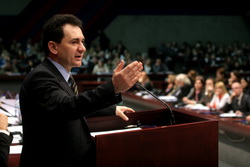
Deputy Prime Minister for EU Integration Bozidar Djelic today opened the Fourth National Conference on Poverty Reduction, at the Sava Centre, at which the latest data on poverty in Serbia in 2008 was presented.
Author:
Tanjug
Djelic said that the number of the poor was reduced from 14% in 2003 to 7% in 2009, adding that stagnation was recorded in the last quarter of 2008 due to the impact of the global crisis.
He said that the government will adopt a package of anti-poverty measures on May 14, which implies increasing the capacities of institutions, adding that funds from the World Bank will be used to decentralise social care services.
The government will ensure an additional several billion dinars for fighting poverty, but it has little room for manoeuvre since it has to implement savings measures because of the arrangement with the IMF. Therefore, certain funds in the public sector will have to be re-allocated, explained the Deputy Prime Minister.
He said he expects that the Law on the protection of competition, scheduled for adoption next week, will help reduce the prices of basic food products.
Djelic said that last year 7.9% of the population is below the poverty line, adding that the largest number of poor was recorded in Vojvodina.
Around 20% of the unemployed were poor, as well as 10% of children and 10% of people over 65 years of age. Single persons living alone, single mothers, village households and families with more than six members were also affected by poverty, Djelic said, adding that this should be improved through faster EU integration and the use of EU funds.
He added that next year IPA funds are to be transformed into budget support.
Director of the World Bank in Serbia Simon Gray will present the Deputy Prime Minister’s team for the implementation of the Poverty Reduction Strategy and the Serbian Statistics Office with the award for the improvement of lives of people in Europe and Central Asia for 2009.
Representatives from ministries, local self-governments, the civil society, the European Commission delegation, the UN and international donors are also attending the conference.
He said that the government will adopt a package of anti-poverty measures on May 14, which implies increasing the capacities of institutions, adding that funds from the World Bank will be used to decentralise social care services.
The government will ensure an additional several billion dinars for fighting poverty, but it has little room for manoeuvre since it has to implement savings measures because of the arrangement with the IMF. Therefore, certain funds in the public sector will have to be re-allocated, explained the Deputy Prime Minister.
He said he expects that the Law on the protection of competition, scheduled for adoption next week, will help reduce the prices of basic food products.
Djelic said that last year 7.9% of the population is below the poverty line, adding that the largest number of poor was recorded in Vojvodina.
Around 20% of the unemployed were poor, as well as 10% of children and 10% of people over 65 years of age. Single persons living alone, single mothers, village households and families with more than six members were also affected by poverty, Djelic said, adding that this should be improved through faster EU integration and the use of EU funds.
He added that next year IPA funds are to be transformed into budget support.
Director of the World Bank in Serbia Simon Gray will present the Deputy Prime Minister’s team for the implementation of the Poverty Reduction Strategy and the Serbian Statistics Office with the award for the improvement of lives of people in Europe and Central Asia for 2009.
Representatives from ministries, local self-governments, the civil society, the European Commission delegation, the UN and international donors are also attending the conference.
-
 Belgrade, 24 July 2026
Dačić congratulates UK Home Secretary on reappointment
-
 Belgrade, 22 July 2026
Serbia follows modern technological achievements, attracts investments
-
 Belgrade, 22 July 2026
Continued cooperation with Russia in field of security, emergency situations
-
 Belgrade, 22 July 2026
New opportunities for expanding economic cooperation between Serbia, China
-
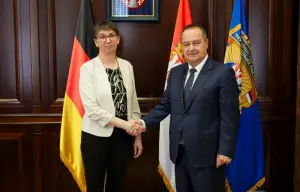 Belgrade, 20 July 2026
Cooperation in field of interior affairs important segment of relations with Germany
-
 Belgrade, 16 July 2026
Expo 2027 opportunity to further strengthen international partnerships
-
 Belgrade/Bratislava, 16 July 2026
Serbia, Slovakia continue to strengthen political, economic cooperation
-
 Belgrade, 14 July 2026
Serbia bilaterally resolves problems arising from EES implementation
-
 Gradina/Kalotina, 9 July 2026
Improving border cooperation between Serbia, Bulgaria
-
 Belgrade, 7 July 2026
Further strengthening economic cooperation between Serbia, Italy