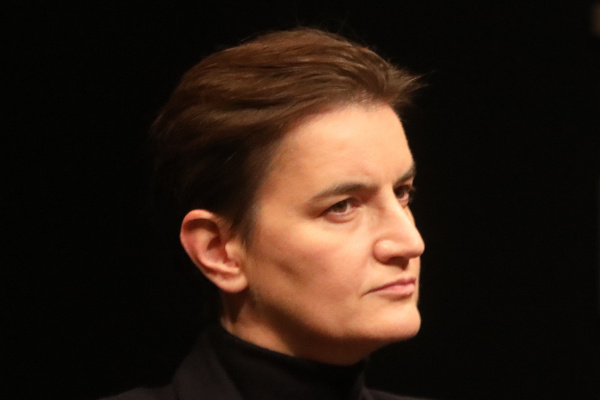
In an exclusive interview with German portal FOCUS, Prime Minister Ana Brnabic underlined that Serbia has never made the issue of vaccines a geopolitical question, but that of saving lives and that the origin of vaccines has never played a role as long as they are safe for use.

Q:
A:
Serbia ensured stable, predictable vaccine rollout
Belgrade/Berlin,
3 February 2021
That is the main reason of the success of our country in the process of immunisation of the population, Brnabic stated.
FOCUS points out that no country in Europe, except for Great Britain, inoculates faster than Serbia, one of the reasons for that being that Serbia uses the Russian and Chinese vaccines too.
Brnabic said that so far, Serbia has vaccinated around 470,000 people, which makes us a pioneer in the region and our country ranks second in Europe in terms of vaccination rate. The main reason for our success is that we have had the opportunity to source vaccines around the world.
At no point have we politicised vaccines and the country of origin did not matter as long as the vaccine are safe. This balance and good partnerships have proven increasingly useful during this time. They gave us the opportunity to purchase vaccines from the West as well as from our friends in China and Russia.
The question about vaccines was simple for us from the start: What do we need to protect our population? How can we get as many doses of vaccines as possible to protect our population, reopen our economy and go back to normality we all long for so much?
It is a strategy that I would encourage. Today the priority is not to debate foreign policy premises, but to do everything possible for the security of our citizens. We are grateful for the support from abroad and thank our tireless health workers who are managing to vaccinate our population in the shortest time possible.
Commenting on the remark that there is widespread criticism of Brussels' vaccine procurement and that the EU had argued that only a joint order would ensure that small countries would also receive the vaccine, and asked if Serbia has refuted this argument, Brnabic said that different countries have taken different approaches to vaccine procurement and that is understandable. Now that we have been running vaccination campaigns for a month, the numbers speak for themselves.
In addition to Great Britain, Serbia has also made rapid progress, while others have unfortunately had to accept delays in the rollout of vaccines. The possibility of negotiating individually with the partners we have chosen ourselves has proven to be very effective for us.
Asked if Serbia learned from Israel - after all, Israeli Prime Minister Netanyahu announced that his country would become the world vaccination champion, Brnabic answered that Israel has done really great in terms of its vaccination programme and we actually got in touch with them to better understand Israel’s success.
Following the example of Israel, we have used our resources to implement this vaccination campaign as safely and quickly as possible, because we know that this is ultimately the only way to protect our people. While there are numerous examples of tensions in global vaccination protection efforts, we rely on cooperation and knowledge sharing - such as through our talks with Israel - to protect our people and make the vaccination process safe.
As more countries successfully source vaccines, we hope to also become a good example of lessons learned and good practice.
Commenting on the remark that Serbia got vaccines from China and Russia and asked whether it is problematic to observe that Europe's conflicts with these two countries are increasing, the Serbian Prime Minister noted that we signed our first contract with Pfizer-BioNTech and our first batch of vaccines came from there. We are one of the first countries in the world to sign a contract with Pfizer.
At the same time, however, as mentioned earlier, we have been on the lookout for all possible partners to ensure a stable and predictable vaccine supply for our population. We are convinced of good relations on all sides - including Russia and China, which, like the EU, were of enormous support to Serbia during the pandemic. Their vaccine deliveries to Serbia are just another example of our partnership.
The pandemic is about saving lives, not about geopolitics. If vaccines are available and we can get them, it is our duty to do so in the interest of our people.
FOCUS underlined that the German health minister says that people who want to get vaccinated must accept a vaccine that is available. Citizens do not have the option to choose between different manufacturers. It is different in Serbia. What is your experience with that?
Brnabic: We realised early on that it was problematic to rely on a single vaccine manufacturer to cover the entire population. When each manufacturer can only allocate a small amount to each country, it is clear that the best approach is to combine different vaccines for the vaccination campaign.
However, our approach requires more coordination and training of vaccination staff to ensure that the differences between the various vaccines are understood. At the same time, the period of time between vaccinations must be respected and citizens must be informed quickly of the dates of their vaccinations. However, we think it is worth the effort.
Brnabic noted that everyone has a different feeling about the different types of vaccines and their origins. Our approach allows us to take people's wishes into account and let them choose which vaccine to receive. This is a unique freedom and we are happy to be able to offer our citizens this opportunity.
Commenting on the remark that the trust of Serbian population in the Russian vaccine is currently greater than in the German-American one and asked what the reason for that is, Brnabic answered that the Serbian citizens are happy to be in one of the few countries in the world with such a successful vaccination start and their trust in all vaccine variants is very high, as is that of the Serbian government.
I myself got vaccinated with the vaccine from Pfizer-BioNTech to demonstrate my confidence in this vaccine right from the start. We have gone to enormous lengths to give our citizens choice while protecting as many people as possible. However, we do not prefer any manufacturer over another. It is up to the population to decide for themselves which vaccine they want to receive.
FOCUS noted that Serbia has reportedly started vaccinating the Serbian population in Kosovo and asked if Serbia is making vaccination a geopolitical issue on this point.
Brnabic explicitly reiterated that fighting the pandemic is about saving lives and protecting people from further economic difficulties. The Kosovo Serbs are not willingly on the wrong side of the border dispute launched by Pristina and we will not punish them for it. In addition, the interim institutions of authority in Pristina have scheduled their vaccination start in February and we are determined not to just sit and watch how Pristina withholds our vaccines from people in cities with predominantly Serbian population or put them at the end of the list. We don't want to take that risk.
She recalled that when Pristina ran out of PCR tests during the pandemic, Serbia sent them some. And the same goes for the vaccines - we are ready to help and support them, but they have to understand that this is not about politics, it is about people's health and safety.
The Prime Minister underlined that digitisation was the key factor in the success of our vaccination campaign as in just a few days, we created a vaccination register, as well as a tracing and monitoring system for managing our vaccination campaign.
This system enables people to register for vaccination quickly. Citizens are then notified by the system (via text message on their smart phones or email) when and where they will receive the vaccine. The system also tracks who already received a vaccine and it also regulates the supply and distribution of vaccines in the entire country.
Brnabic added that as a result of the digitalisation of the Serbian education system, we are one of the few countries in the world where children did not miss a single day of school during the pandemic.
As Prime Minister, I have made digitisation of education system one of the government's top priorities since 2017. We have equipped our schools with high-speed Internet connection, started introducing digital textbooks and classrooms, and trained the majority of our teachers.
She noted that the digitisation of all schools in Serbia is scheduled to be completed in 2022. So when the pandemic struck, it was relatively easy for us to hold classes online. I don't expect any significant changes in teaching at the moment. We will continue our multi-level education programme as long as we can keep everyone safe. Currently, older secondary school students have face-to-face classes every two weeks, while younger students attend school three days a week. In primary schools, classes are split into two, with one half being taught in the morning and the other half in the afternoon.
Asked about her opinion on whether the pandemic will change Europe, Brnabic underlined that the pandemic has shown how difficult it can be to first provide and distribute personal protective equipment and now vaccines.
The fact is that the pandemic has already changed Europe. However, the hope is that we will all learn from these difficulties and setbacks. Europe will put the pandemic under control - as well as other pandemics that are likely to remain inevitable in the future. The world needs the European Union just as Serbia needs it. It will emerge stronger from these challenges, the Prime Minister concluded.
-
 Belgrade, 1 August 2026
More affordable, accessible medicines demonstrate state’s systemic care for citizens’ health
-
 Belgrade/Ohrid, 31 July 2026
Strengthening good-neighbourly relations, cooperation with North Macedonia
-
 Belgrade, 31 July 2026
Appeal to citizens to use electricity rationally
-
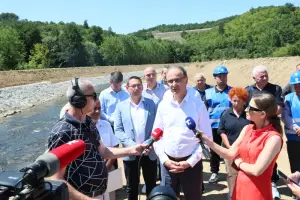 Vladičin Han, 31 July 2026
State continues to invest in water management infrastructure throughout Serbia
-
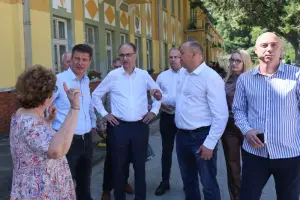 Vranjska Banja, 31 July 2026
Capacities of Vranjska Banja for further development of spa tourism to be improved
-
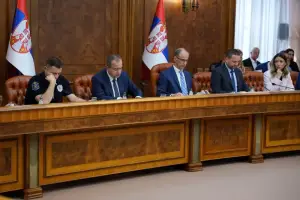 Belgrade, 30 July 2026
Coordinated state response to adverse weather conditions
-
 Vranje, 30 July 2026
Continuing investment in protection of cultural heritage
-
 Vranje, 30 July 2026
State responds quickly to citizens’ needs
-
 Belgrade, 30 July 2026
Government continues to work solely in citizens’ interest