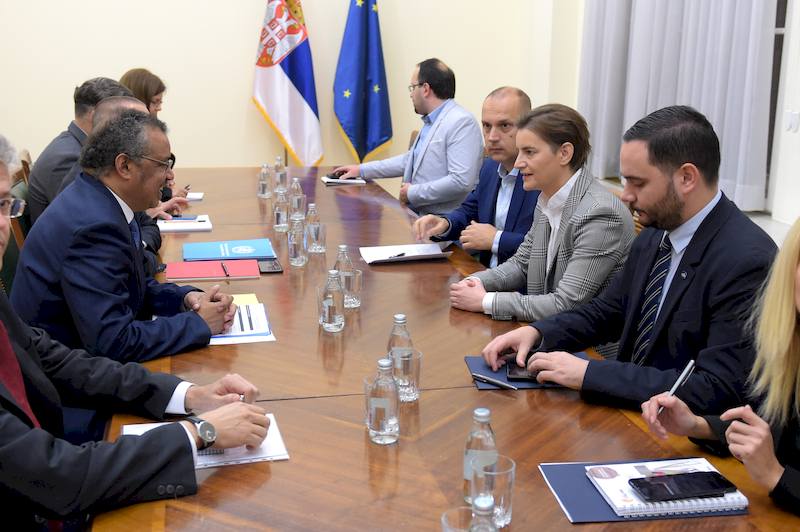
Prime Minister Ana Brnabic pointed out today during the talks with Director-General of the World Health Organization (WHO) Tedros Adhanom Ghebreyesus the importance of our country's cooperation with this organization, aimed at improving the health and well-being of Serbia’s citizens.

Q:
A:
Serbia committed to fulfilling WHO goals
Belgrade,
17 October 2019
Brnabic said that Serbia has put universal health care at the top of its health policy priorities, and that it has set up an Interagency Working Group to Implement the United Nations Sustainable Development Agenda by 2030.
She stated that our country has made significant progress in the field of universal health care over the last 10 years, and now the average life expectancy in Serbia is 75.4 years.
According to Brnabic, the Serbian government adopted a Public Health Strategy by 2026 with the aim of eliminating the main causes of mortality, such as cardiovascular disease, stroke and type 2 diabetes.
Addressing the issue of the increased influx of migrants and health issues related to this topic, the Prime Minister pointed out that 3,000 migrants currently reside in Serbia, and that the domestic health system adequately responded to the new situation and that all migrants were vaccinated.
The WHO Director-General expressed satisfaction with the cooperation with Serbia and commended our country for the results achieved in the field of universal health care coverage.
At the meeting it was also noted that in 2017 Serbia adopted the Law on Ratification of the Protocol on the Elimination of Illicit Trafficking in Tobacco Products, thus confirming its commitment to the goals of the WHO and the UN.
The meeting was also attended by Serbian Health Minister Zlatibor Loncar.
-
 Belgrade, 2 August 2026
Energy sector facing serious, challenging situation
-
 Belgrade, 2 August 2026
Preserving ties with Serbian people worldwide among government’s priorities
-
 Belgrade, 1 August 2026
More affordable, accessible medicines demonstrate state’s systemic care for citizens’ health
-
 Belgrade/Ohrid, 31 July 2026
Strengthening good-neighbourly relations, cooperation with North Macedonia
-
 Belgrade, 31 July 2026
Appeal to citizens to use electricity rationally
-
 Vladičin Han, 31 July 2026
State continues to invest in water management infrastructure throughout Serbia
-
 Vranjska Banja, 31 July 2026
Capacities of Vranjska Banja for further development of spa tourism to be improved
-
 Belgrade, 30 July 2026
Coordinated state response to adverse weather conditions
-
 Vranje, 30 July 2026
Continuing investment in protection of cultural heritage
-
 Vranje, 30 July 2026
State responds quickly to citizens’ needs