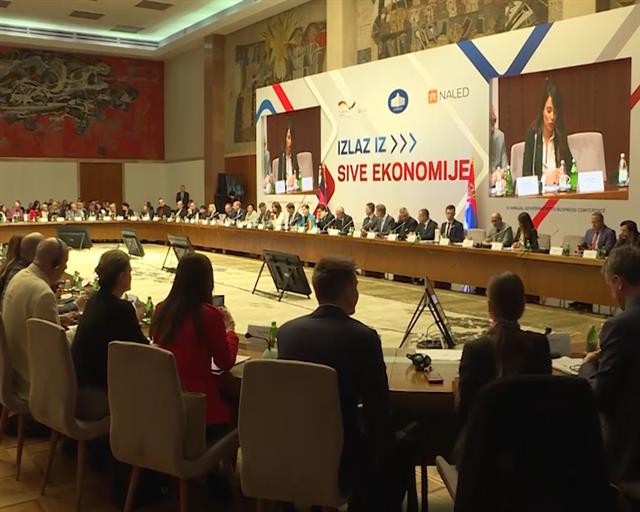
Prime Minister Ana Brnabic today announced at the 4th annual conference of the Government of the Republic of Serbia and the Serbian economy “Exit from Gray Economy” that the state will continue resolutely to fight the gray economy and that there will be no compromise.

Q:
A:
There will be no compromise in fight against gray economy
Belgrade,
22 May 2019
At the opening of this meeting, at which the new National Programme for the Suppression of the Gray Economy was presented with the 2019/20 Action Plan, she said that this is the only way to ensure fair conditions for the economy that operates in accordance with the laws and pays taxes.
She said that this is a partnership project of the government of the Republic of Serbia and the National Alliance for Local Economic Development (NALED) towards creating a fair market.
Under the programme, which is supported by the German Development Cooperation Agency (GIZ), 36 measures and 153 activities are foreseen in this regard.
The new National Programme foresees a reduction by almost €200 million in the gray zone and the transfer of at least 11,000 workers and 9,000 gray business firms into legal flows over the next two years.
The programme aims to achieve five goals: more efficient supervision, improvement of the work of the Tax Administration, introduction of incentive measures for legal business and employment, reduction of administrative and parafiscal burden, and awareness raising on the fight against the gray economy.
NALED Board Member Svetoslav Atanasov said that the most important measures for the economy are the promotion of legal business and the reduction of bureaucracy and costs.
Ambassador of Germany Thomas Schieb estimated that Serbia has achieved good economic results in the past years, but that the gray economy is still a problem, which includes up to 30% of GDP.
The fourth annual conference is organized by the Government of the Republic of Serbia and the National Alliance for Local Economic Development (NALED), supported by the German Development Cooperation Agency (GIZ).
-
 Belgrade, 2 August 2026
Energy sector facing serious, challenging situation
-
 Belgrade, 2 August 2026
Preserving ties with Serbian people worldwide among government’s priorities
-
 Belgrade, 1 August 2026
More affordable, accessible medicines demonstrate state’s systemic care for citizens’ health
-
 Belgrade/Ohrid, 31 July 2026
Strengthening good-neighbourly relations, cooperation with North Macedonia
-
 Belgrade, 31 July 2026
Appeal to citizens to use electricity rationally
-
 Vladičin Han, 31 July 2026
State continues to invest in water management infrastructure throughout Serbia
-
 Vranjska Banja, 31 July 2026
Capacities of Vranjska Banja for further development of spa tourism to be improved
-
 Belgrade, 30 July 2026
Coordinated state response to adverse weather conditions
-
 Vranje, 30 July 2026
Continuing investment in protection of cultural heritage
-
 Vranje, 30 July 2026
State responds quickly to citizens’ needs