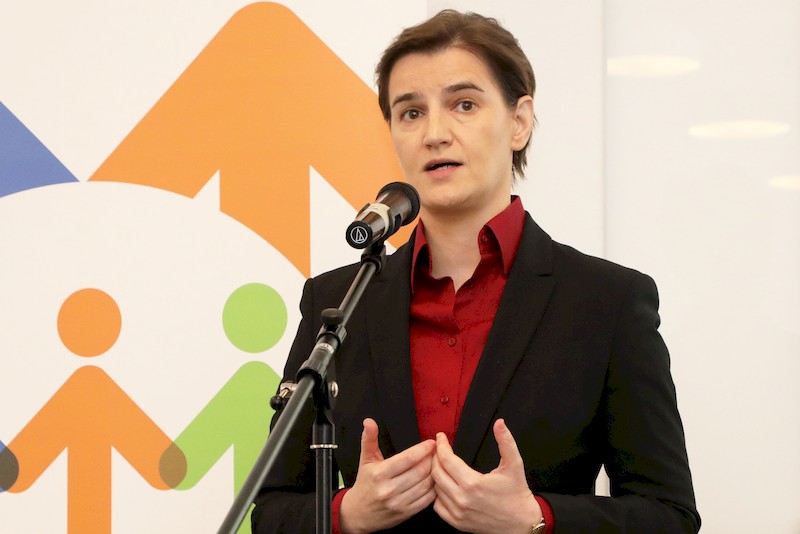
Prime Minister Ana Brnabic said today that Serbia has political guarantees that it will not be adversely affected by the introduction of the quotas for import of steel in the EU, so the Serbian economy and the Smederevo steelworks, owned by the Chinese Hesteel, are completely safe at the moment.

Q:
A:
Serbia will not be affected by EU steel import quotas
Belgrade,
16 January 2019
In a statement to journalists at the Serbian-Korean Centre, Brnabic said that these guarantees stem from the Stabilisation and Association Agreement that we have with the European Union.
She explained that out of the three relevant categories in the steel production on the basis of which the decisions on quotas are made, for the first Serbia will have no quotas, but only a global quota for the EU, and for the other two categories it will probably have quotas, but with the possibility to raise them automatically.
According to her, the EU's steel quotas will be effective as of 4 February, and from April Serbia will be able to raise them and enter the global quota.
We also agreed on a clause saying that we can show at any time that we are concerned about our production. If we prove this with data, we can further negotiate the quotas, Brnabic said.
She pointed out that the restriction of steel imports to the EU is not directed against Serbia and the Western Balkans, or against China, and explained that these measures were imposed.
The United States was the first one to impose protectionist measures towards the EU for the steel market, which is the most delicate for the EU because the steel production is what the EU was created on so it had to fight back, Brnabic said.
Brnabic also said that the European Union has no fears from the visit of Russian President Vladimir Putin to Belgrade, and stated that it is important for Serbia to have good relations with everyone.
-
 Belgrade/Subotica, 3 August 2026
Investment in modern railway infrastructure among government’s priorities
-
 Belgrade, 3 August 2026
Energy situation in Serbia fully stable
-
 Belgrade, 2 August 2026
Energy sector facing serious, challenging situation
-
 Belgrade, 2 August 2026
Preserving ties with Serbian people worldwide among government’s priorities
-
 Belgrade, 1 August 2026
More affordable, accessible medicines demonstrate state’s systemic care for citizens’ health
-
 Belgrade/Ohrid, 31 July 2026
Strengthening good-neighbourly relations, cooperation with North Macedonia
-
 Belgrade, 31 July 2026
Appeal to citizens to use electricity rationally
-
 Vladičin Han, 31 July 2026
State continues to invest in water management infrastructure throughout Serbia
-
 Vranjska Banja, 31 July 2026
Capacities of Vranjska Banja for further development of spa tourism to be improved
-
 Belgrade, 30 July 2026
Coordinated state response to adverse weather conditions