Prime Minister Ana Brnabic said today at the opening of the conference "Towards a Safer Serbia", held in Belgrade, that four major challenges are ahead of Serbia: migration, terrorism, high-tech crime and the situation in Kosovo-Metohija.

Q:
A:
Frozen conflict in Kosovo potential source of threat for citizens
Belgrade,
5 October 2018
Brnabic assessed that the specificity of the situation in Kosovo is such that we have a frozen conflict, which is a potential source of security threat for our citizens for several reasons, and above all because we increasingly see the senseless attacks of Pristina authorities, from which we do not know what we can expect.
The Prime Minister pointed out that Pristina does not fulfill its obligations under the first agreement between Belgrade and Pristina – the Brussels Agreement, and that, therefore, Serbia does not have a partner on the other side on whom it can count.
She assessed that migration is a challenge not only for Serbia, but for the whole of Europe, noting that during the period of the migrant crisis in 2015 and 2016, Serbia has proven to have security forces that can meet all the challenges and protect its borders and citizens, but also showed that it is humane and that it can deal with the registration of so many migrants.
Serbia, although it did not have problems with terrorism, invests much and monitors every security threat that can come from that direction in order to remain a safe country, said the Prime Minister, adding that our country has a strategic assessment of public security from 2017 to 2021, which defines eight priorities.
These are the fight against organised crime, suppression of the production and smuggling of drugs, corruption, high-tech crime and terrorism, as well as improvement of the state of law and order and traffic conditions, as well as the fight against irregular migration, Brnabic said.
Speaking about the effect of Serbia's security forces, she said that 13.7 tons of narcotics were seized between April 2014 and August 2018, which is a 43% increase over the same period four years ago.
She also provided data that in 2018 only, Serbia reduced the number of crimes by about 5.2% and prosecuted 15 criminal groups.
-
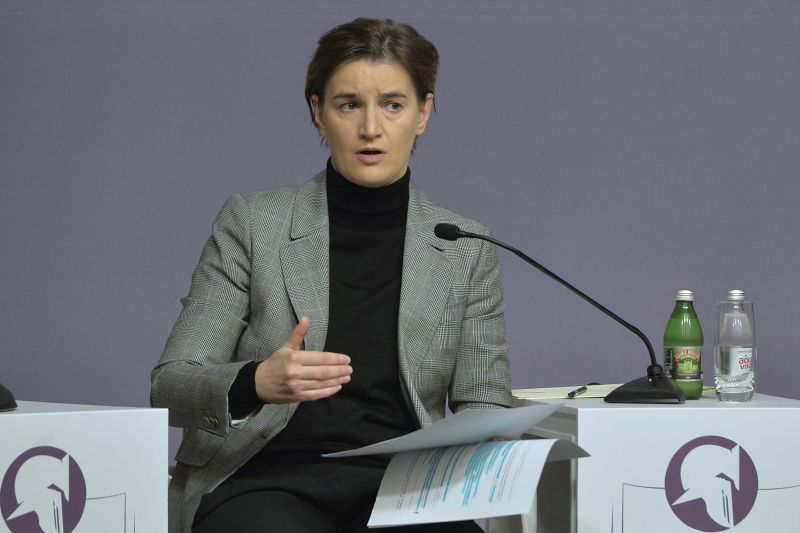 Author: Tanjug
-
 Belgrade, 4 August 2026
Hosting European Under-21 Championship major recognition for Serbia
-
 Belgrade, 4 August 2026
Preserving memory of Operation Storm victims our moral obligation
-
 Belgrade/Subotica, 3 August 2026
Investment in modern railway infrastructure among government’s priorities
-
 Belgrade, 3 August 2026
Advancing bilateral relations between Serbia, São Tomé and Príncipe
-
 Belgrade, 3 August 2026
Energy situation in Serbia fully stable
-
 Belgrade, 2 August 2026
Energy sector facing serious, challenging situation
-
 Belgrade, 2 August 2026
Preserving ties with Serbian people worldwide among government’s priorities
-
 Belgrade, 1 August 2026
More affordable, accessible medicines demonstrate state’s systemic care for citizens’ health
-
 Belgrade/Ohrid, 31 July 2026
Strengthening good-neighbourly relations, cooperation with North Macedonia
-
 Belgrade, 31 July 2026
Appeal to citizens to use electricity rationally