
Q:
A:
EBRD ready to finance structural projects in Serbia
Belgrade,
16 July 2007
Serbian Deputy Prime Minister Bozidar Djelic and European Bank for Reconstruction and Development (EBRD) President Jean Lemierre stated after meeting today that EBRD is ready to finance structural projects in Serbia worth several hundred million euros and invite large investors to invest more in Serbia.
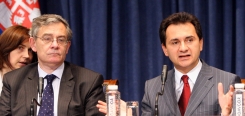
Jean Lemierre, left, and Bozidar Djelic at today's press conference
Djelic told a press conference that the government will seek EBRD financial support for projects in the public sector and for finding large international investors that are ready to invest between €300 million and €1.5 billion in greenfield investment in Serbia, allowing for construction of large production capacities capable of exporting to the international market.
He expressed expectation that EBRD will help in realisation of contacts with managements of large international companies for such endeavours.
The Serbian Deputy Prime Minister said that there are four priority projects: loans of nearly €60 million for the purchase of locomotives and cars for the railway, €20 million for construction of a large power station in Belgrade, €100 million for recapitalisation of Komercijalna Banka and €80 million for completion of the Belgrade ring-road.
Djelic also said that EBRD is ready for recapitalisation of Komercijalna Banka, which has started to expand and is operating in Bosnia-Herzegovina and is the most serious candidate for the takeover of a Macedonian bank.
It was agreed with EBRD President that loans in the private sector resulted in attraction of new investments and accelerated development whereas in the public sector, initial good results were succeeded by a lag in reforms, he said.
Djelic added that the Serbian government will therefore initiate projects in the public sector with funds from the National Investment Plan, EBRD loans, loans from the European Investment Bank (EIB), from the EU budget and from private sector.
According to him, the aim is to boost employment and competitiveness of the Serbian economy so as to reduce the high foreign trade deficit.
Djelic recalled that EBRD in 2001 approved €919 million, €519 million of which was used to support financial sector and large infrastructure projects.
Lemierre said that EBRD’s prime task will be to help the government create new jobs and reduce the foreign trade deficit, noting that the key for solving these problems is increasing competitiveness of the Serbian economy.
For that to happen, EBRD will financially support infrastructure in Serbia, invest in share capital and help in pulling in fresh foreign investments, Lemierre announced.
He added that energy saving projects are being worked on and noted that Belgrade needs bridges and that municipalities in Serbia need better infrastructure.
Djelic also said that Serbia’s credit rating is stable.
He expressed expectation that EBRD will help in realisation of contacts with managements of large international companies for such endeavours.
The Serbian Deputy Prime Minister said that there are four priority projects: loans of nearly €60 million for the purchase of locomotives and cars for the railway, €20 million for construction of a large power station in Belgrade, €100 million for recapitalisation of Komercijalna Banka and €80 million for completion of the Belgrade ring-road.
Djelic also said that EBRD is ready for recapitalisation of Komercijalna Banka, which has started to expand and is operating in Bosnia-Herzegovina and is the most serious candidate for the takeover of a Macedonian bank.
It was agreed with EBRD President that loans in the private sector resulted in attraction of new investments and accelerated development whereas in the public sector, initial good results were succeeded by a lag in reforms, he said.
Djelic added that the Serbian government will therefore initiate projects in the public sector with funds from the National Investment Plan, EBRD loans, loans from the European Investment Bank (EIB), from the EU budget and from private sector.
According to him, the aim is to boost employment and competitiveness of the Serbian economy so as to reduce the high foreign trade deficit.
Djelic recalled that EBRD in 2001 approved €919 million, €519 million of which was used to support financial sector and large infrastructure projects.
Lemierre said that EBRD’s prime task will be to help the government create new jobs and reduce the foreign trade deficit, noting that the key for solving these problems is increasing competitiveness of the Serbian economy.
For that to happen, EBRD will financially support infrastructure in Serbia, invest in share capital and help in pulling in fresh foreign investments, Lemierre announced.
He added that energy saving projects are being worked on and noted that Belgrade needs bridges and that municipalities in Serbia need better infrastructure.
Djelic also said that Serbia’s credit rating is stable.
-
 Belgrade, 19 June 2026
Serbia committed to protecting refugees, improving asylum system
-
 Belgrade, 19 June 2026
Visit of BYD representatives confirms strengthening of economic cooperation with China
-
 Belgrade/Bratislava, 9 June 2026
Agreement signed with Slovakia on joint surveillance of Serbia’s state border
-
 Belgrade, 3 June 2026
Bizerba continues to develop production in Serbia
-
 Belgrade, 2 June 2026
Small entrepreneurs driving force of domestic economy
-
 Belgrade, 1 June 2026
Serbia joins Frontex Partnership Academies Network
-
 Belgrade/Shanghai, 28 May 2026
Commercial contracts signed with leading Chinese companies
-
 Belgrade/Jiaxing, 27 May 2026
Serbia entering new phase of technological, industrial development
-
 Belgrade, 27 May 2026
Dačić extends Kurban Bayram greetings
-
 Belgrade/Jinan, 26 May 2026
Strengthening international standing, economy through cooperation with China