First Deputy Prime Minister and Minister of Foreign Affairs Ivica Dacic and Minister of Foreign Affairs of Spain Jose Manuel Albares assessed today that the economic cooperation of the two countries has improved significantly, but that there is room for further progress.

Q:
A:
Further improvement of cooperation between Serbia, Spain
Belgrade,
13 April 2023
At a joint press conference with Albares, Dacic stated that the foreign trade exchange of the two countries reached almost €1.5 billion, but that it is important to continue working on the improvement of economic relations.
He emphasised that the relations between the two countries are excellent and friendly and that they are on the rise, and new momentum was given to those relations by last year's visit to Serbia by Prime Minister of Spain Pedro Sanchez, and also by President of Serbia Aleksandar Vucic’s visit to Madrid.
The First Deputy Prime Minister pointed out that Serbia is grateful to Spain for its firm stance, which is of great help to us, when it comes to the principles of preserving sovereignty and integrity.
When we talk about Kosovo and Metohija, we are not only talking from the point of view of our interests, but also from the point of view of respect for the universal principles of international law, Dacic said, pointing out that this attitude of Spain is extremely important for Serbia.
He said that Serbia also supports the integrity and sovereignty of Spain in relation to various separatist ideas and movements that are also trying to achieve their goals with unilateral acts.
Albares stated that the main topics of the conversation were bilateral relations between the two countries, dialogue between Belgrade and Pristina, as well as how to bring the Western Balkans closer to the European Union.
He said that the Western Balkans can count on Spain during its presidency of the EU, adding that Spain undertook to support Serbia in its European aspirations by the Memorandum of Understanding, which he signed yesterday with Minister of European Integration Tanja Miscevic.
The Minister said that the tour of this region began with a visit to Serbia because Serbia is an important partner of Spain in all areas of cooperation, noting that the foreign trade exchange between the two countries has exceeded €1 billion and that Spain wants its companies to be more present in Serbia.
He particularly emphasised the importance of the work of the Cervantes Institute in Belgrade, the only one of its kind in the Balkans, which plays an important role in cultural exchange and contributes to greater learning of the Spanish language.
-
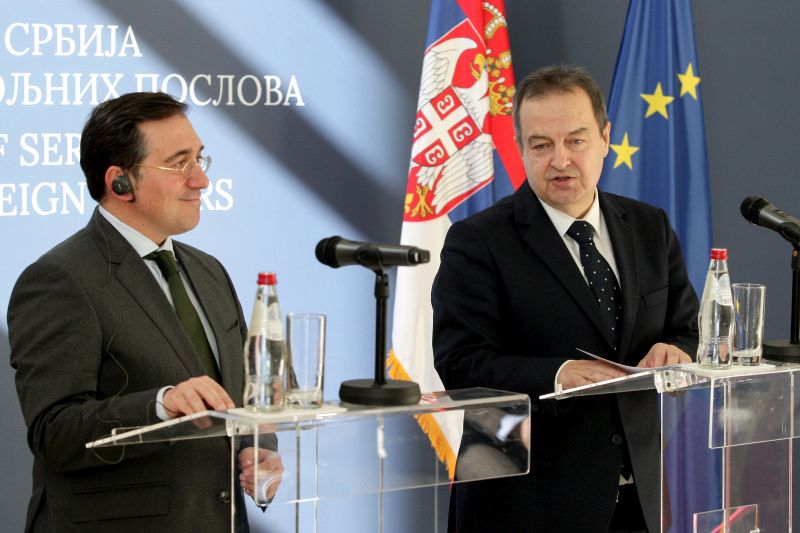 Jose Manuel Albares, left, and Ivica Dacic at today's press conferenceAuthor: Tanjug
-
 Belgrade, 16 July 2026
Expo 2027 opportunity to further strengthen international partnerships
-
 Belgrade/Bratislava, 16 July 2026
Serbia, Slovakia continue to strengthen political, economic cooperation
-
 Belgrade, 14 July 2026
Serbia bilaterally resolves problems arising from EES implementation
-
 Gradina/Kalotina, 9 July 2026
Improving border cooperation between Serbia, Bulgaria
-
 Belgrade, 7 July 2026
Further strengthening economic cooperation between Serbia, Italy
-
 Belgrade, 6 July 2026
Serbia serious, responsible partner in fight against crime
-
 Kać, 3 July 2026
Additional foreign investment confirms confidence in Serbia
-
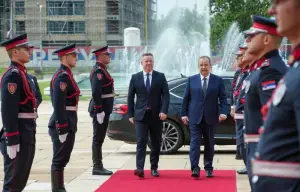 Belgrade, 3 July 2026
Serbia, Hungary reliable partners in maintaining security
-
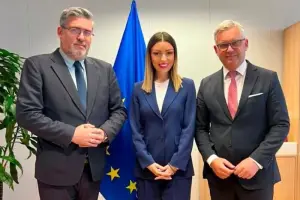 Belgrade/Brussels, 3 July 2026
Serbia committed to further developing partnership relations with EU
-
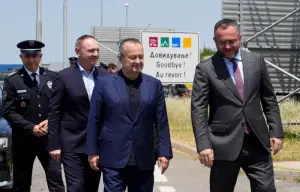 Preševo, 1 July 2026
Joint campaign by Serbia, North Macedonia for safer travel