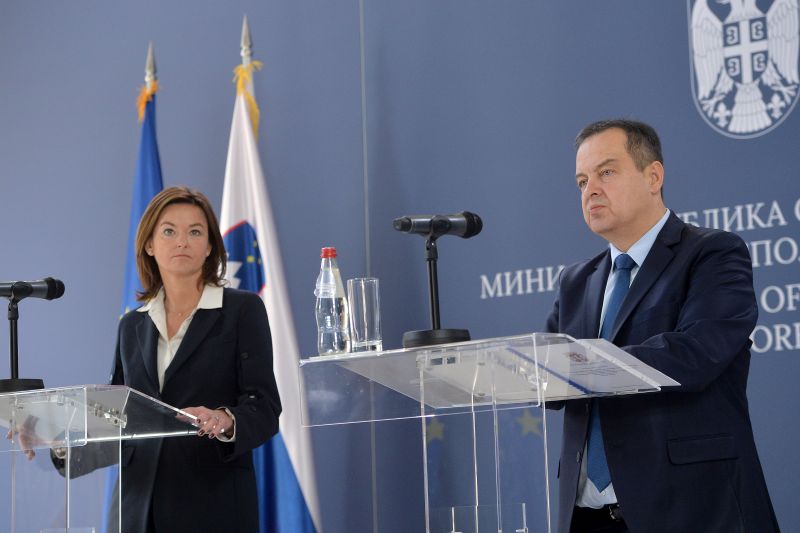
First Deputy Prime Minister and Minister of Foreign Affairs Ivica Dacic met today with Deputy Prime Minister and Minister of Foreign Affairs of Slovenia Tanja Fajon, expressing his gratitude to Slovenia for the support it provides to our country regarding European integration.

Q:
A:
High degree of economic cooperation with Slovenia
Belgrade,
20 December 2022
At a joint media conference, after talking with Fajon, Dacic said that Slovenia has offered assistance in the form of professional staff in certain areas when it comes to reforms.
The two ministers announced the date of the joint session of the two governments, where they assessed that there is a high level of economic cooperation, which, according to Serbian data, amounts to €1.4 billion.
The First Deputy Prime Minister said that Fajon is familiar with the problems in Kosovo and Metohija, recalling that the Brussels Agreement was signed nine years ago and that it is clear that the Prime Minister of Pristina's temporary institutions, Albin Kurti, does not want to implement it.
Fajon emphasised that the normalisation of relations between Belgrade and Pristina is the most important in order to ensure the best possible life for citizens, underlining that respect for the Brussels Agreement is crucial for further cooperation.
She repeated that Slovenia wants Serbia to accede to the EU as soon as possible, and at the same time praised our country for taking positive steps in the matter of harmonising the visa policy with the policy of the Union.
The two countries, as she assessed, have excellent political and economic cooperation, with approximately 1,500 Slovenian companies operating in Serbia and providing 25,000 jobs.
Dacic, answering the journalists' questions, pointed out that the elimination of the causes of the latest events in Kosovo and Metohija can lead to de-escalation of the situation in the province.
According to him, the prime minister of the temporary institutions of Pristina, Albin Kurti, is currently the biggest threat to peace and stability, because he causes individual incidents.
Dacic said that all the events in Kosovo and Metohija are the result of non-compliance with the Brussels Agreement, adding that the Serbs did not set up barricades to obstruct traffic, but as a political protest due to the non-fulfilment and violation of that agreement.
-
 Author: Tanjug
-
 Belgrade, 20 July 2026
Cooperation in field of interior affairs important segment of relations with Germany
-
 Belgrade, 16 July 2026
Expo 2027 opportunity to further strengthen international partnerships
-
 Belgrade/Bratislava, 16 July 2026
Serbia, Slovakia continue to strengthen political, economic cooperation
-
 Belgrade, 14 July 2026
Serbia bilaterally resolves problems arising from EES implementation
-
 Gradina/Kalotina, 9 July 2026
Improving border cooperation between Serbia, Bulgaria
-
 Belgrade, 7 July 2026
Further strengthening economic cooperation between Serbia, Italy
-
 Belgrade, 6 July 2026
Serbia serious, responsible partner in fight against crime
-
 Kać, 3 July 2026
Additional foreign investment confirms confidence in Serbia
-
 Belgrade, 3 July 2026
Serbia, Hungary reliable partners in maintaining security
-
 Belgrade/Brussels, 3 July 2026
Serbia committed to further developing partnership relations with EU