
Q:
A:
Ministers of the Serbian Government on the positive Feasibility Study
13 April 2005
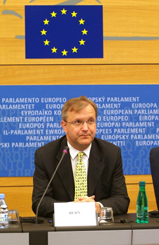
European Commissioner on Enlargement Olli Rehn
Author:
Fonet
Serbia-Montenegro has received a positive assessment of the Feasibility Study on a Stabilisation and Association Agreement with the European Union, European Enlargement Commissioner Olli Rehn told a press conference in Strasbourg, France, on April 12.
A feasibility study is a specific report by which the European Commission informs the EU Council of Ministers on a country’s preparedness to establish certain institutional ties with the EU. The report on Serbia-Montenegro was prepared by the EC’s Delegation in Belgrade and the Working Group from Brussels.
The study contains a series of chapters determining whether the domestic legislation in certain fields has been harmonised with the EU. Countries surveyed by such a study must also meet certain economic and political criteria, including the establishing of democratic institutions and the rule of law, respect for human rights, protection of minorities, regional cooperation, and meeting international obligations, which in Serbia-Montenegro’s case means full cooperation with the International Criminal Tribunal for former Yugoslavia (ICTY).
A positive feasibility study is forwarded to the EU Council of Ministers, which should approve it and order the EC to open official negotiations on a Stabilisation and Association Agreement.
The main conclusion of the Feasibility Study for Serbia-Montenegro is that since the democratic changes in 2000, the country has made significant progress in reaching political and economic criteria in the process of stabilisation and association with the EU.
In the 64-page document, the EC concluded that Serbia-Montenegro has made significant progress in building capacities to ensure that the Stabilisation and Association Agreement can be implemented after its adoption.
Despite the fragility of the democratic process, largely due to the legacy of the old regime, the EC considers that Serbia-Montenegro is sufficiently prepared to negotiate a Stabilisation and Association Agreement and it recommends the EU Council of Ministers to open negotiations.
In the meantime, Serbia-Montenegro is expected to press ahead with its progress in all fields of the country’s economic and political life, primarily in establishing full cooperation with the ICTY, respect of the Constitutional Charter, strengthening of democratic functioning of the state union’s and individual republics’ parliaments, executive authorities, as well as further improvement of human rights, the protection of minorities, and reforms in public administration.
The Serbian government’s official web site brings initial reactions of the ministers to the positive Feasibility Study.
Minister of Justice Zoran Stojkovic Minister of Capital Investment Velimir Ilic Minister of Economy Predrag Bubalo Minister of Energy and Mining Radomir Naumov Minister of Interior Dragan Jocic Minister of Health Tomica Milosavljevic Minister of Science and Environmental Protection Aleksandar Popovic Minister of Agriculture, Forestry and Water Management Ivana Dulic-Markovic Minister of Labour, Employment and Social Policy Slobodan Lalovic Minister of Public Administration and Local Self-Government Zoran Loncar Minister of Religion Milan Radulovic Minister of Culture Dragan Kojadinovic Minister for Diaspora Vojislav Vukcevic Minister of Education and Sport Slobodan Vuksanovic Minister of Trade, Tourism, and Services Bojan Dimitrijevic
A feasibility study is a specific report by which the European Commission informs the EU Council of Ministers on a country’s preparedness to establish certain institutional ties with the EU. The report on Serbia-Montenegro was prepared by the EC’s Delegation in Belgrade and the Working Group from Brussels.
The study contains a series of chapters determining whether the domestic legislation in certain fields has been harmonised with the EU. Countries surveyed by such a study must also meet certain economic and political criteria, including the establishing of democratic institutions and the rule of law, respect for human rights, protection of minorities, regional cooperation, and meeting international obligations, which in Serbia-Montenegro’s case means full cooperation with the International Criminal Tribunal for former Yugoslavia (ICTY).
A positive feasibility study is forwarded to the EU Council of Ministers, which should approve it and order the EC to open official negotiations on a Stabilisation and Association Agreement.
The main conclusion of the Feasibility Study for Serbia-Montenegro is that since the democratic changes in 2000, the country has made significant progress in reaching political and economic criteria in the process of stabilisation and association with the EU.
In the 64-page document, the EC concluded that Serbia-Montenegro has made significant progress in building capacities to ensure that the Stabilisation and Association Agreement can be implemented after its adoption.
Despite the fragility of the democratic process, largely due to the legacy of the old regime, the EC considers that Serbia-Montenegro is sufficiently prepared to negotiate a Stabilisation and Association Agreement and it recommends the EU Council of Ministers to open negotiations.
In the meantime, Serbia-Montenegro is expected to press ahead with its progress in all fields of the country’s economic and political life, primarily in establishing full cooperation with the ICTY, respect of the Constitutional Charter, strengthening of democratic functioning of the state union’s and individual republics’ parliaments, executive authorities, as well as further improvement of human rights, the protection of minorities, and reforms in public administration.
The Serbian government’s official web site brings initial reactions of the ministers to the positive Feasibility Study.
Minister of Justice Zoran Stojkovic Minister of Capital Investment Velimir Ilic Minister of Economy Predrag Bubalo Minister of Energy and Mining Radomir Naumov Minister of Interior Dragan Jocic Minister of Health Tomica Milosavljevic Minister of Science and Environmental Protection Aleksandar Popovic Minister of Agriculture, Forestry and Water Management Ivana Dulic-Markovic Minister of Labour, Employment and Social Policy Slobodan Lalovic Minister of Public Administration and Local Self-Government Zoran Loncar Minister of Religion Milan Radulovic Minister of Culture Dragan Kojadinovic Minister for Diaspora Vojislav Vukcevic Minister of Education and Sport Slobodan Vuksanovic Minister of Trade, Tourism, and Services Bojan Dimitrijevic