
Mr. President,
Excellencies,
Ladies and Gentlemen,
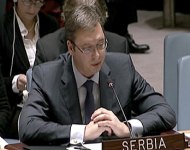
Thank you for the opportunity to present the perspective of the Republic of Serbia of the situation and events in Kosovo and Metohija in the period from July to October this year.
Mr. President,
More than anything else, Serbia wants stability, political and economic, in the entire Western Balkans. This is the condition for the survival and progress of our Serbia, as well as of all others'. It is preciously for this reason that Serbia is committed to peace and life, that, independently and without pressures from outside, it has commenced difficult and comprehensive reforms aimed at bringing about a healthier and more competitive economy, a freer and richer citizen. We do not invent problems outside the borders of our country and we do not raise nationalistic tensions in the region, because we have enough courage to face and solve our own problems courageously, Serbia, therefore, has stayed away from conflicts in the region, even from verbal ones, for only weak and irresponsible politicians, whenever they have internal problems, open old nationalistic wounds and confuse issues, turning the region backwards. We have no part in it. And we are not weak because of it. On the contrary. It is the sign of our strength and a long-term, strategic thinking.
All of you in this august forum know well the importance of Kosovo and Metohija for my country and all its citizens, as well as the attention with which the Republic of Serbia follows the developments in its southern Province administered, under UNSC resolution 1244 (1999), by the United Nations Interim Administration Mission in Kosovo (UNMIK). Our genuine and long-term commitment to a peaceful solution of the conflict in Kosovo and Metohija is well known to all members of the international community, both those who share our views on the status of Kosovo and Metohija and those who think otherwise. I believe that you all recognize, just as well, the resolve in the steps that the Republic of Serbia has taken lately to give momentum to the reconciliation among the people living in Kosovo and Metohija and improve the living conditions of all its residents, Albanians, Serbs, Gorani, Roma and the members of other non-majority communities alike.
Serbia welcomes the efforts made by the United Nations and UNMIK, European Union (EU), North Atlantic Treaty Organization and its presence in Kosovo and Metohija (KFOR), as well as the efforts made by the Organisation for Security and Cooperation in Europe (OSCE), aimed at achieving the same goals of reconciliation, economic progress and security of all residents of Kosovo and Metohija.
Serbia trusts the United Nations. If it weren't for UNMIK, the world would be without much of the data on the events in Kosovo and Metohija.
We salute the activities of H.E.Mr. Ban Ki-moon, Secretary-General of the United Nations, and H.E. Mr. Farid Zarif, Head of UNMIK, who presented the UNMIK report for the period from 16 July to 15 October 2014.
You know that Belgrade is firm in its position not to recognize the secession of Kosovo and Metohija and its self-proclamation into a State, carried out by force and contrary to international law. Yet, this firm position is not an obstacle to negotiations and an ever more lively communication with Pristina today.
This is so because Belgrade, the Government of the Republic of Serbia, wants peace and stability in the entire region, it wants dialogue and a solution, as well as that people, goods and ever more positive ideas circulate freely throughout the region.
It is therefore right to say that these efforts of ours, the new, positive approach of Serbia to the difficult Balkan questions, have eased the tensions in the region in which there is less and less fear among neighbours and more and more acceptance of initiatives coming from Serbia.
We have proved by our acts that we want more than anything else peace in the Balkans as the basis of its development. We want a normal, decent and ordered Serbia and are well aware that it is possible only in the same environment.
Likewise, we know that dialogue is the only way to achieve this goal and we shall do all so that it be continued in the way Serbia has promoted it: by taking decisions that improve the life of people in Kosovo and Metohija.
Surely, this will not prevent Serbia from continuing to insist on its position that the unilateral declaration of independence of Kosovo and Metohija is illegal; yet, probably, for the first time in many years, this position of the Government of Serbia does not impede the life in the Province.
On the contrary, we are dedicated to that life, putting it before any other interest.
At the same time, this gives us the right to request for the Serbs in Kosovo and Metohija exactly what we want for the Albanians: the possibility to live, work, be safe, communicate and move around normally.
We therefore believe that everything that Serbia has done in the last two years towards spreading and promoting these positions deserves attention, recognition and support.
We do so primarily because our desire for peace and cooperation in the entire Balkans is the only way to make that region an equal part of Europe in the way, Mr. President, that will not make the Balkans different from Europe at all.
We do so also because we demonstrate, day in, day out, that centuries-old conflicts, vast differences and completely opposed positions do not have to obstruct dialogue and solutions.
We only need to promote dialogue and solutions into the supreme value and the most important goal.
This is exactly what this Government of Serbia has done.
This report is regular, yet far from routine for the Republic of Serbia. That a document is submitted regularly must not mean that it is drawn up lightly. We are therefore convinced that the authors of the report wrote it with special attention, well aware of its importance for the people of the Province, the Republic of Serbia and the environs. We read the report carefully not to maliciously find fault with it, but to present, with it in mind, proposals for the improvement of the situation in the Province. This report is important for us, it is being listened to by the entire world today, while the Serbs of Kosovo and Metohija look to it, just as they look to our response, for the confirmation of their just demands. I shall therefore touch on a number of issues brought up in this document.
It is said in the introductory part of the report that the "priorities of the Mission remain to promote security, stability and respect for human rights" in Kosovo and Metohija. Well, if the said areas were all right, they would not be "priorities". Yet, regrettably, not even the basic preconditions for normal life have been created in Kosovo and Metohija so that today, more than fifteen years after the arrival of international presences, the Security Council needs to discuss how to ensure the elementary living conditions, for Serbs and other non-Albanians in Kosovo and Metohija in the first place. We therefore consider that the role of UNMIK should continue to be strengthened in the areas of the current competencies of the Mission, whereas the weakening of the role it has been entrusted with would lessen its capacity to fulfill its mandate, particularly in the areas of vital importance for Serbs and other non-Albanians living in Kosovo and Metohija.
We must not disregard the importance of the trust that the Serbian and other non-Albanian populations in Kosovo and Metohija have placed in UNMIK, either. That trust underscores the need for a more active and visible presence and engagement of the Mission in Kosovo and Metohija.
Today, Mr. President, in the second decade of the twenty-first century, there are still people in one part of Europe who cannot tend their fields or frequent and pray in their places of worship without fear. And their children go to school in fear. This dark picture is the defeat of modern civilization and, sadly, a daily occurrence in the life of many Serbs and non-Albanians of Kosovo and Metohija.
In addition to the so-called "northern Kosovo", singled out at one point as a separate area of monitoring, attention should also be accorded, in accordance with the basic priorities of UNMIK such as promoting, and I quote, "security, stability and respect for human rights", the life and numerous difficulties encountered by Serbs every day in the so-called "south of the Ibar River" area, i.e. in other parts of Kosovo and Metohija. The life of Serbs in enclaves all over the Province is quiet, modest and difficult; they live in today's ghettos, to the shame of Europe and the world. This is the common knowledge of all UNMIK members who have been there, as well as the obligation of each and every righteous servant of the United Nations to report the plight and predicament of these Serbian towns and villages to the world. This is why the regular UNMIK Reports should address the harsh realities in which Serbs "south of the Ibar River" live with special attention.
We want and must speak of the people that live there. Both north and south of the River.
We want and must defend their life; their right to work, to move freely, to be free, to go to school, to receive medical treatment and to be able to protect themselves.
It is precisely for these reasons that nobody can speak of Serbian chauvinism, a new Republic of Srpska or hegemonistic aspirations today.
The right to life is universal and untouchable.
Serbia, too, has the right to fight for this right.
This atl the more so as, this time, Serbia does not demand for the members of its people anything that it is not ready to give to the members of other peoples.
Life, set as a frontier, calls for solutions like these.
Because, after all, we were given life to preserve, protect and respect. Ours and other peoples'.
Serbia and its Government have decided unequivocally to respect each and every life in Kosovo and Metohija. And requests that "each and every life" encompasses the lives of the Serbs in Kosovo and Metohija as well.
That is why today, as we wait and seek a solution to the Kosovo and Metohija knot, we have nothing to be ashamed of. And have no reason to respond to all conditions that we have had set overtly or covertly otherwise than that we have already done it.
Because, through our attitude and platform, we have done precisely every single thing that the world has asked us to do over years.
Ladies and Gentlemen,
We have normalized relations with Pristina. We talk to Pristina, we seek joint solutions with Pristina, we respect the demands of Pristina and our attitude towards Pristina and the Albanians is not the attitude that we would have towards somebody who has not the same rights that we demand for the members of our people.
After a century of conflicts, wars and victims, this Government has made a step forward towards the Albanians that, surely, can be called historic.
Instead of conflict, this Government chose agreement, instead of problems - solutions and, most importantly, instead of death - life.
This is the life and the rights that we demand for Serbs as well.
Mr. President,
The Republic of Serbia is firmly committed to continuing its active and constructive participation in negotiations with Pristina at all levels and to implementing the agreements reached so far.
We are ready to continue the process. Yet, our willingness to negotiate does not mean that we are weak; our constructiveness does not mean that we acquiesce easily; and our belief does not mean that we are nai've.
Unfortunately, we miss a collocutor at the other end of the table: the administrative organs of the Provisional Institutions of Self-Government (PISG) in Pristina have not been formed yet, half a year after the elections. We expect that they will be formed in the coming days.
Yet, without waiting for a Government to be formed in Pristina, the Republic of Serbia has implemented a whole range of measures that it committed itself to by the Brussels Agreement. We amended the Law on Higher Education and adopted a new Cadastre Regulation to make the implementation of relevant agreements possible.
With respect to the freedom of movement, we approved the bearers of identity documents issued by PISG in Pristina to cross the border crossings at Nikola Tesla and Konstantin Veliki international airports in Belgrade and Nis, as well as the 4 busiest crossings to Hungary, Croatia, Bulgaria and Macedonia.
Also, a number of high-ranking PISG officials attended important regional conferences and other events in Belgrade in the reporting period.
We regret the lack of progress in the implementation of the key segment of the Brussels Agreement related to the establishment of the Community of Serbian Municipalities (CSM) in Kosovo and Metohija. Prior to the dissolution of the Parliament in Pristina no preparations of the legal framework were made for effective implementation of the competencies of the future Community in the field of economic development, education, health and urban and rural planning in the CSM territory as provided for by Article 4 of the Brussels Agreement. For its part, the CSM management team has made a CSM Draft Statute and is ready to send it to the Committee on the Implementation of the Brussels Agreement.
Let me point in this context to the problem of the integration of 30 former members of the Ministry of the Interior (MI) of the Republic of Serbia from Kosovo and Metohija into the Kosovo Police Service (KPS) in the municipalities in northern Kosovo and Metohija. Although the Government of the Republic of Serbia has fully implemented the relevant agreements and terminated their employment, these members have not been advised of the status of their applications, let alone admitted or fully integrated into the KPS, yet. Likewise, the integration of the former MI administrative staff and the firefighters has not begun, either.
Distinguished Members of the Council,
The Republic of Serbia cannot accept the part of the report related to northern Kosovo and Metohija, that part of it, that is, in which the situation in the locality of Brdjani, in northern Kosovska Mitrovica, is presented fragmentarily and therefore inaccurately. To the disappointment of my country, this part of the report is silent about the basic problem of the area: through land usurpation and illegal construction, the Kosovo and Metohija Albanians continue to press, every which way, for changes of the ethnic structure of northern Kosovska Mitrovica.
According to the information of the officials of the Municipality of Kosovska Mitrovica North, the Albanians plan to build 172 housing units in the locality of Brdjani for the veterans of the so-called Kosovo Liberation Army who never, and I repeat never, lived there and a small number of Albanians who did, prior to 1999. This serves to relativize the action of the local Serbian population taken, rightly, in protest against the attempts to artificially change the demographic picture on the ground and paint it in negative colours as unfounded and unconstructive. Instead, it would be very easy to prove what exactly the previous situation was like and take measures to prevent politically motivated changes of the demographic structure in
northern Kosovo and Metohija.
Let me also point out here that the criminal proceedings against Zubin Potok Municipal President Stevan Vulovic and other Serbs from the Municipality of Zubin Potok serve to put political pressure to bear on, and prevent the running of, the Municipality as a local self-government with Serbian majority. The prosecutions also serve to derail the implementation of the First Agreement on Principles Governing the Normalization of Relations between Belgrade and Pristina, providing for unencumbered running of municipalities with Serbian majorities in Kosovo and Metohija.
With respect to the situation in the field of security, the report does mention the problems in the implementation of laws, in particular at the local level. The Serbs and their property are targeted in the maiority of ethnically motivated attacks, while personal and property insecurity remains the main obstacles to the sustainable return of the Serbian population to localities from which they were expelled.
Mr. President,
I have to bring to the attention of the Council the tragic death of Gendarme Stevan Sindjelic. He was shot and killed by the members of armed illegal logging gangs from Kosovo and Metohija in the Ground Safety Zone along the administrative boundary line between Kosovo and Metohija and Central Serbia on 28 August. It is impermissible that groups of civilians, armed with automatic rifles, roam freely, cut wood illegally and attack the security forces of the Republic of Serbia as they attempt, quite legally, to prevent them from doing so.
It is also my duty to bring to the attention of the Council that, on 28 August, the Feast of the Dormition, once celebrated by the townspeople of Djakovica as their patron saint's day, the displaced citizens of this town of Serbian nationality were prevented once again from visiting the holy places in their place of birth because they had been told that international forces could not guarantee their security. The people of Djakovica had the same problem also on Christmas Eve when Albanians stoned their buses, while on All Souls' Day they were prevented from visiting the graves of friends and relatives.
The Serbs from Suva Reka were also prevented from marking the same religious holiday in a dignified way. A few hundred Albanians in the village of Musutiste blocked the passage to displaced Serbs to the local Orthodox church in which they intended to celebrate the Feast of the Dormition. The extremists blocking the passage carried Albanian flags and posters with offensive messages.
If the displaced Serbs cannot visit the towns and villages in which they were born or the graves of their relatives on only one day in a year and without fear for their safety, the sincerity of the call of the provincial institutions to displaced Serbs to return is very much in doubt, just as is the capacity of these institutions to ensure personal and property security to all residents of Kosovo and Metohija.
The Government of the Republic of Serbia is also deeply worried that a flag of the Republic of Serbia was removed from the fortress at Zvecan in the night between 14 and 15 October and that another Serbian flag, flown on the building of the Treasury Department in northern Kosovska Mitrovica, was burned on 16 October.
Mr. President,
The Republic of Serbia calls on all responsible and active factors in the international community to pay maximum heed to the conclusions of Chief Prosecutor of the European Union Special Investigative Task Force Clint Williamson. He says in his Statement that compelling evidence has been found to file an indictment against senior officials of the so-called Kosovo Liberation Army responsible for the persecution of Serbs and the Roma, as well as of Kosovo and Metohija Albanians. The campaign of persecution included murders, abductions, disappearances, illegal detentions in camps in Kosovo and Metohija and Albania, sexual violence, as well as other forms of inhuman treatment, such as forced displacement and the destruction of churches and other religious sites. And it must not be allowed that those responsible for the most heinous crimes be acquitted for the lack of evidence, caused by brutal intimidation of witnesses.
Oliver Ivanovic, leader of the Civic Initiative Serbia, Democracy, Justice, was apprehended at the end of last January and indicted at the beginning of August. The first hearing was held in the Basic Court of Kosovska Mitrovica on 26 August within the joint case with Dragoljub Delibasic, retired Head of the Police Department of Kosovo and Metohija, Ilija and Nebojsa Vujacic and Aleksandar Lazovic, indicted for grave criminal offences and war crimes committed in 1999 and 2000. All the indictees pleaded not guilty on all
counts of the indictment. The custody of Oliver Ivanovic was extended until 26 October 2014 and then for another 2 months.
Yet, only 2 days after the EULEX Prosecutor raised the indictment against Ivanovic and requested extension of the custody for him, the Court released on bail Ismet Haxha, one of the indictees in the Drenica Group case, charged with war crimes against civilians committed at Likovac in 1998 and 1999. Haxha obstructed the rest of the trial, hiding in the Clinical Centre of Pristina. The instances of double standards evident in the practice of the judiciary in Kosovo and Metohija, Mr. President, instill fear and insecurity in Serbian and other non-Albanian communities in the Province.
The events related to the so-called case of Klecka that include the striking out of the evidence of the key witness because of the changes in criminal laws and, as a consequence, the acquittal of Fatmir Limaj and his co-defendants, charged with murder, torture and threats to the health of Serbian and Albanian civilians and PoWs, the subsequent re-opening of the case and the unbecoming reactions of the officials in Pristina to the apprehension of Limaj and his co-defendants in which the revision of the EULEX mandate was requested in the Assembly of Kosovo and, finally, Limaj's release from prison to house arrest are telling evidence of the corruption and the non-functioning of the justice system in Kosovo and Metohija which is, like the international presences in the Province, under strong influence of the political elites in Pristina.
The concern of the Government of the Republic of Serbia over the work of the judiciary in Kosovo and Metohija is very pertinent in the light of the disclosures that a serious doubt exists with respect to the spread of corruption within EULEX, including bribes given to cease proceedings in dozens of cases against Kosovo and Metohija Albanians and the fabrication of evidence in the ever more senseless case of Oliver Ivanovic.
To fully implement the Brussels Agreement and the previous agreements in the technical dialogue between Belgrade and Pristina, the Republic of Serbia has fulfilled its obligations. Pristina, however, has failed to take the necessary steps so far to comply with its part of obligations in key areas, such as inadequate solutions in the Amnesty Law, Law on the Budget and the Law on Local Self-Government.
In assessing the constitutionality of the Amnesty Law, the so-called "Constitutional Court of Kosovo" assessed as unconstitutional the Articles of the Law that grant amnesty for acts of destruction or damage to the property of others, damage to movable property, arson, damage to items belonging to other persons, document forgery and special cases of document forgery, so that these acts are excluded from amnesty. The acts that are also excluded from the Amnesty Law are those that can be used by the PISG judiciary organs to prosecute persons of Serbian nationality in Kosovo and Metohija. In this context, it is pointed out that, in their dissenting opinions, international judges of the Constitutional Court of Kosovo Robert Carolan, United States, and Almiro Rodriguez, Portugal, said that, contrary to the decision of the
Constitutional Court, the amnesty of the said acts is not unconstitutional.
Ladies and Gentlemen,
The Government of the Republic of Serbia expresses its deep concern over the incidents caused by the members of the majority community in Kosovo and Metohija on a continual basis, aimed at preventing Serbs and other non-Albanians from returning to their homes from which they were expelled. Let me give you just a few sad examples that are indicative of the manner the attacks are being carried out on returnee houses and other property.
On 22 August, unknown perpetrators fired at the home of Tomislav Dabetic in the village of Saljinovica, Municipality of Istok. Fortunately, the returnee family was not at home at the time of the attack. Upon arrival home, however, they noticed damages on the house: a bullet went through a window and a door and ended in the bathroom. The incident spread fear and anxiety among the people of Saljinovica, as well as among all those intent to return to this village, all the more so as the victim of the attack was a family that never did any harm to anybody.
At the end of August, 5 houses were demolished in the centre of Djakovica. They belonged to the Serbian Stefic family, the original settlers who began to build the town literally from scratch. The demolition was carried out at the direct order of Municipal President Mimoza Kusari Lila, whereby a clear message was sent to the Serbs that they are not welcome back. I recall in this connection that 12,000 Serbs lived in Djakovica prior to 1999; today, only 4 elderly ladies remain, living on the monastery premises.
In the night between 7 and 8 October, unknown perpetrators broke into the houses and appendant buildings of the Serbian returnee families of Miletic, Konic and Tosic in the village of Grabac, Municipality of Klina, stealing much of their movable property and causing considerable material damage. There is no doubt that this act was motivated by the intention to intimidate potential returnees and discourage them from returning to Kosovo and Metohija.
Accordingly, it may be noted that the overall trend of decelerating the returns of displaced Serbs of Kosovo and Metohija is continued and that PISG in Pristina have not done enough to fulfil their obligations and facilitate the return of the expellees. The return of the internally displaced persons (IDPs) is being prevented by numerous administrative obstacles and the adopted return procedures are insurmountable practical barriers for Serbs and other non-Albanians to return to their centuries-old homes. They are catalysts of lasting changes in the demographic picture of the entire Province, too.
It is my duty to remind the Council that the Republic of Serbia is the country which has the greatest number of IDPs in Europe with 230,000 people in this status, 18,000 of them in Kosovo and Metohija itself.
Even fifteen years after the expulsion, only 2,000 out of 4,000 IDPs who returned home, realized the right to sustainable return because of the lack of basic security, economic and social preconditions.
Of particular concern is the situation in the field of the protection of cultural and religious heritage in Kosovo and Metohija in the reporting period.
At the beginning of September, unknown persons removed the plaque on the road Velika Hoca - Zociste, unveiled on 21 August by the members of the Journalists' Association of Serbia in honour of the memory of abducted colleagues Djura Slavuj and Ranko Perenic at the place where the 2 reporters of Radio Pristina were kidnapped in 1998. Most probably, the plaque and the concrete pedestal were uprooted from the ground with a tractor or a construction machine and the removal was noted on 11 September. This is the third time that the plaque has been vandalized and removed.
The threat to the security of, and the pressure being constantly brought to bear on, the monks of one of the holiest Serbian places of worship, Visoki Decani Monastery, included in the UNESCO World Heritage List, is particularly worrisome. In the night between 11 and 12 October, the graffiti in red and black were scribbled on the walls of the appendant buildings on the Monastery estate. They included "ISIS", "The Caliphate is coming", UQK (so-called Kosovo Liberation Army) and AKSh (so-called Albanian National Army), while 2 graffiti were in Arabic. The KPS and KFOR were notified of the incident and they carried out an investigation. During the investigation, a group of Albanian extremists congregated in front of the Monastery, provoking and intimidating the Serbian monks as they shouted "UQK!" As early as the next evening the graffiti "ISIS' and "AKSh" were scribbled on the Monastery gate all over again.
There is no doubt that, if allowed, the authors of the graffiti would conduct in Kosovo and Metohija the same policy of evil, hatred and death, condemned by the entire civilized and justice- and freedom-loving world, that is much in evidence these days in parts of Iraq, Syria and Lebanon, the 'realm' ruled by the terrorists of ISIS. The experience of decades past and the present practice frighten Serbs in Kosovo and Metohija. If the United Nations is unable to provide protection to a site that its specialized agency put on the World Heritage List, how safe then will be the houses, schools and places of worship of non-Albanian residents of the Province?
Mr. President,
In our assessment, the report is deficient in the segment related to the protection of the property rights of the residents of Kosovo and Metohija. Apart from a short account of the work of the Kosovo Property Agency and the information of the number of cases dealt with in the reporting period and the number of unsolved cases before the Agency, the report is silent on the situation of the property of Serbs and other non-Albanians.
No mention is made of the manner in which property cases are solved by this Agency, i. e. whether the usurper has left the property in question, whether the owner has entered into possession of his/her property and whether the request for the restitution of property has been rejected. Also, in line with previous reports, no mention is made of the fate of the abandoned property of Serbs and other non-Albanians in Kosovo and Metohija which is liable to renewed usurpation by Albanians, subject to fraudulent transactions between Albanian buyers and alleged owners and exposed to destruction and damage, as well as ungrounded expropriation by municipal authorities without proper compensation or with no compensation at all.
The fate of 18,500 complaints of Serbs and non-Albanians for compensation for the destroyed or damaged property is mentioned nowhere in the Report; they are rejected en mass and the courts demand from the complainants whose complaints have been rejected to pay high litigation fees even though the complainants are IDPs in a difficult material situation who had requested courts to be exonerated from payment of the expenses.
The report does not go beyond reporting only the number of completed cases before the Kosovo Property Agency this time round, either. Consequently, it informs of the number of decisions rather than the number of their enforcements, i.e. the number of owners entered into possession. A decision to restitute a usurped property in Kosovo and Metohija, Mr. Presient, is still miles away from the actual restitution of the property to, i. e. the entry into possession by, the original owner. In addition to personal insecurity, this is one of the main reasons why IDP returns to Kosovo and Metohija are far from being satisfactory.
The privatization process conducted by the Privatization Agency of Kosovo continues to evolve in contravention of International and European Conventions on Human Rights. Public and socially-owned companies in Serbian communities are privatized much more frequently and their sale to persons of Albanian nationality deprives these communities of economic resources, providing additional impulse to the exodus of the Serbian population from Kosovo and Metohija.
Let me recall that, in its reply of 22 April 2013 to the letters of the Office for Kosovo and Metohija of the Government of the Republic of Serbia requesting that an end be put to privatization conducted contrary to UNSC resolution 1244 (1999), UNMIK said that indeed the privatization through the Privatization Agency of Kosovo is contrary to the said resolution and UNMIK regulations since the Privatization Agency of Kosovo is not a legal successor of the Kosovo Trust Agency as it was not established on the basis of a Law
that was in force in Kosovo and Metohija in accordance with the said resolution.
A specific problem has been created by the decision of the Privatization Agency of Kosovo to liquidate hotel Junior in the Municipality of Strpce. A collective accommodation centre for 85 IDPs is housed in the hotel and in case of its sale, the IDPs would be displaced once again, a practice morally unacceptable from the humanitarian point of view.
I have to advise the Council of the serious intention of the PISG in Pristina to expropriate the immovable property of physical persons and legal entities in the territory of the Municipality of Strpce under the pretext of the construction of a tourist centre. The property is owned by more than 820 physical persons and legal entities, including the Inex Sky Centre Brezovica, preponderantely of Serbian extraction, the majority population in the Municipality.
Bearing in mind that almost all owners and property holders are of Serbian nationality, we are of the opinion that the intended expropriation is discriminatory and that the land confiscation from the persons of Serbian nationality will result in an exodus of the remaining Serbian population and the change of the ethnic structure of the Municipality of Strpce. The PISG actions violate the rights of the Serbs from Strpce, guaranteed by the European Convention on Human Rights and Fundamental Freedoms.
Also, the PISG in Pristina are attempting to appropriate the property of the Republic of Serbia in Kosovo and Metohija in an unlawful way, oblivious of the fact that the question of the property of the Republic of Serbia and the property of economic entities in the territory of Kosovo and Metohija will be the subject-matter of the negotiation process conducted by the Republic of Serbia with the PISG with the mediation of the European Union.
Serbia looks forward to the resumption of negotiations with Pristina, because it brings peace and stability to the entire region. Serbia is committed, Mr. President, to reforms and will make no compromises in this regard. Count on Serbia as a pillar of stability and, very soon, a modern and successful country.
Mr. President,
Distinguished Members of the Security Council,
I thank you for your attention.