
Q:
A:
Serbia won’t agree to Kosovo-Metohija’s independence
Berlin,
24 October 2007
Serbian Deputy Prime Minister Bozidar Djelic stated in Berlin, following a meeting with Chair of the Bundestag Committee for the Affairs of the European Union Gunther Krichbaum, that Serbia is constructive in the talks on Kosovo-Metohija future status, but added that the province’s independence is a line Serbia will not cross.
Djelic stressed that Serbia firmly believes compromise is attainable and that as for the talks on the province, Belgrade is not the side rejecting all proposals, but that for months it has been the side that has kept providing proposals, offering ideas and an organisational form which is original and may lead to compromise.
Djelic said that Serbia proposes that Kosovo-Metohija has its own tax and monetary policy, access to international financial organisations, representatives in the spheres of economy and culture and its own path in talks with the EU.
However, Serbia cannot have its territorial integrity damaged and a new state appear on its territory, stressed Djelic and added that compromise is possible and an original solution must be found.
He said it is very good that institutional ties between Belgrade and Pristina have been discussed in the course of the talks lately, since it is obvious that this is the direction towards which the two sides should go in order to find a compromise solution.
Djelic said that the agreement between East and West Germany from 1972 on the regulation of mutual relations can be an element of the solution to Kosovo-Metohija, though it is unacceptable as a whole because that way Kosovo-Metohija would be given a chair in the UN, which Serbia cannot accept.
According to Djelic, a compromise solution is attainable and it means true safety not only for Serbia, but also for the stability of the Balkans, because that way it would be possible to prevent numerous Pandora’s boxes from opening and frozen conflicts from re-emerging. Also, various separatist movements worldwide would not be given encouragement, he added.
Krichbaum said that Germany supports a compromise solution for the Serbian province, but that the negotiating process must not last too long as it would not be good for stability in the Balkans.
As for the visa regime, Djelic said he is very pleased with the clear support he got concerning further liberalisation for Serbia’s visa regime with the EU.
It is clear that Serbia will earn the right to join the white Schengen list, therefore we are not asking for privileges. We will simply do all we can to convince citizens of Germany and other EU states that opening borders for Serbian citizens does not imply any risks, but on the contrary, an opportunity to work together and get to know each other better, explained Djelic.
Krichbaum said it is very important that Serbian citizens are given the green light for visa relaxations as soon as possible and added that once the agreement on visa relaxations comes into force next year, the change will be noticeable.
Before addressing the press together, Krichbaum and Djelic attended a session of the Bundestag Committee for the Affairs of the European Union.
Djelic said that Serbia proposes that Kosovo-Metohija has its own tax and monetary policy, access to international financial organisations, representatives in the spheres of economy and culture and its own path in talks with the EU.
However, Serbia cannot have its territorial integrity damaged and a new state appear on its territory, stressed Djelic and added that compromise is possible and an original solution must be found.
He said it is very good that institutional ties between Belgrade and Pristina have been discussed in the course of the talks lately, since it is obvious that this is the direction towards which the two sides should go in order to find a compromise solution.
Djelic said that the agreement between East and West Germany from 1972 on the regulation of mutual relations can be an element of the solution to Kosovo-Metohija, though it is unacceptable as a whole because that way Kosovo-Metohija would be given a chair in the UN, which Serbia cannot accept.
According to Djelic, a compromise solution is attainable and it means true safety not only for Serbia, but also for the stability of the Balkans, because that way it would be possible to prevent numerous Pandora’s boxes from opening and frozen conflicts from re-emerging. Also, various separatist movements worldwide would not be given encouragement, he added.
Krichbaum said that Germany supports a compromise solution for the Serbian province, but that the negotiating process must not last too long as it would not be good for stability in the Balkans.
As for the visa regime, Djelic said he is very pleased with the clear support he got concerning further liberalisation for Serbia’s visa regime with the EU.
It is clear that Serbia will earn the right to join the white Schengen list, therefore we are not asking for privileges. We will simply do all we can to convince citizens of Germany and other EU states that opening borders for Serbian citizens does not imply any risks, but on the contrary, an opportunity to work together and get to know each other better, explained Djelic.
Krichbaum said it is very important that Serbian citizens are given the green light for visa relaxations as soon as possible and added that once the agreement on visa relaxations comes into force next year, the change will be noticeable.
Before addressing the press together, Krichbaum and Djelic attended a session of the Bundestag Committee for the Affairs of the European Union.
-
 Belgrade, 3 June 2026
Bizerba continues to develop production in Serbia
-
 Belgrade, 2 June 2026
Small entrepreneurs driving force of domestic economy
-
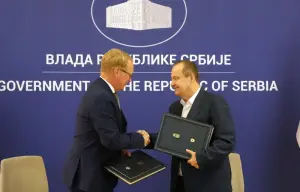 Belgrade, 1 June 2026
Serbia joins Frontex Partnership Academies Network
-
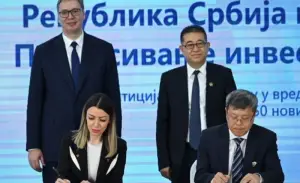 Belgrade/Shanghai, 28 May 2026
Commercial contracts signed with leading Chinese companies
-
 Belgrade/Jiaxing, 27 May 2026
Serbia entering new phase of technological, industrial development
-
 Belgrade, 27 May 2026
Dačić extends Kurban Bayram greetings
-
 Belgrade/Jinan, 26 May 2026
Strengthening international standing, economy through cooperation with China
-
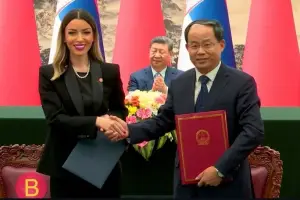 Belgrade/Beijing, 25 May 2026
Opening new opportunities to strengthen economic cooperation with China
-
 Belgrade, 25 May 2026
Serbia committed to developing cooperation with Singapore in field of security
-
 Belgrade, 23 May 2026
Dačić sends telegram of condolences over tragedy in mine in China